

The missing mortgage / an Oftu field study

Why cheaper homes
can be harder
to finance.

A low price is not
a financing plan.

Begin the story
Conceptual folded-paper home on a full-sized stack of mortgage documents: a smaller house still carries a processing file.
Generated conceptual artwork. Paperwork scale is a metaphor, not a measured cost comparison.

The house fits. The loan does not.

Begin with a house that costs $100,000.

This is a thought experiment: a buyer with $20,000 for the down payment, seeking an $80,000 mortgage. Keep the transaction ordinary enough that we can see where it becomes difficult.

At an assumed fixed rate of 7 percent over 30 years, the principal-and-interest payment would be about $532 a month. That is arithmetic, not a rate offer. Taxes, insurance, maintenance, closing costs and the buyer's other obligations still need to be accounted for. The down payment is not all the cash the purchase will require. The CFPB's Loan Estimate guide distinguishes these separate costs for good reason. Loan Estimate explainer

For now, suppose the house is sound, the title is clear and the household can support the full cost. Suppose, in other words, that we have not hidden the usual affordability problems inside a conveniently small payment.

Would the buyer necessarily be able to get the loan?

We tend to imagine mortgage access as a test of the person applying. The lender looks at income, debts, savings and credit, then decides whether the applicant can be trusted with the money.

But another calculation sits beside that one. Will the transaction be worth doing for the business that must arrange it?

The first question concerns the buyer's capacity to pay. The second concerns the lender's capacity to earn. A smaller balance may help the first while making the second harder.

This is the uncomfortable possibility at the inexpensive end of American housing: the home can become cheaper without becoming easier to buy.

The problem is not that every $100,000 house deserves a mortgage. It is that price alone tells us less about access than we think.
The historical evidence / completed sales

The price is lower.
Access is not assured.

CSV

Mortgage-financed share of completed sales

0%100%
Homes below $150,00026%
Higher-priced homes71%
Pew, June 2023 · 1,440 studied counties · 2018–2021. Rounded published shares. Not approval or denial rates, a national 2026 estimate, or a count of excluded households.

A low price is not a financing plan

In research published in June 2023, Pew examined home sales and mortgage originations from 2018 through 2021 in 1,440 counties. About 26 percent of properties selling for less than $150,000 were financed with a mortgage, compared with 71 percent of higher-priced properties. Pew's small-mortgage study

Those are financing shares among completed sales. They are not application approval rates. They are not a fresh count of the market in October 2026. And the remainder cannot be counted as families denied a loan: some buyers wanted to pay cash; some properties might not have qualified for financing. Pew could not observe their physical condition.

The distinction matters. A chart can show a large gap and still leave the cause unresolved.

Yet the gap changes the question worth asking. If mortgage financing is much less common at the bottom of the price distribution, what does an inexpensive listing actually offer to a household that needs to borrow?

The listing supplies a price. It does not supply the route from savings to ownership.

Imagine two buyers standing outside our hypothetical house. One has $100,000 available. The other has $20,000 and a dependable income. If suitable financing is unavailable to the second, the same price means something quite different to each.

This comparison does not establish who buys low-cost homes nationwide. It explains a mechanism. Cash can confer an advantage even when the cash buyer offers no more for the house: it removes the need for a lender to find the transaction attractive.

So the useful argument is not that every cash sale represents a stolen opportunity. It is that a purchase market can look open by price and remain restricted by the way buyers are able to pay.

Housing affordability is usually discussed as a ratio. Here it is also a route.

The loan process

The paperwork does not
shrink with the house.

Smaller principal does not guarantee proportionately less work. Schematic, not measured labor or time.

$80,000 principal
  1. Verify

    Income, assets and information

  2. Underwrite

    Risk and conditions

  3. Title

    Search, examine and insure

  4. Close

    Documents and funding

$240,000 principal
  1. Verify

    Income, assets and information

  2. Underwrite

    Risk and conditions

  3. Title

    Search, examine and insure

  4. Close

    Documents and funding

Conceptual comparison. Actual processes and expenses vary with the borrower, property, lender and funding channel. Equal stages do not assert equal measured costs.

The paperwork does not shrink with the house

Making a mortgage requires more than transferring money. Someone must establish what is being financed, verify the applicant's position, arrange the closing and produce a transaction that meets the lender's and the funding channel's requirements.

A smaller loan does not make a person's identity easier to verify. It does not automatically make a title question simpler. A modest house can have complicated records; an expensive one can have straightforward records.

The Urban Institute's August 2026 analysis identifies fixed origination expenses as a barrier to small-dollar lending: much of the work can remain similar while the revenue associated with the loan amount falls. Its proposed responses include reducing avoidable costs and changing lenders' incentives. Urban's small-loan analysis

The word fixed is doing important work. It does not mean every lender faces the same expense. It means an expense need not decline in proportion to the principal balance.

Consider a purely illustrative $600 task. Against an $80,000 loan, it is 0.75 percent of the balance. Against a $240,000 loan, it is 0.25 percent. Nothing about the task became cheaper. The denominator became larger.

This is how a modest dollar cost becomes a large percentage cost.

It also explains why asking a lender to process a smaller loan for a proportionately smaller reward need not produce a proportionately smaller business. The work has people, systems and responsibility attached to it. Those obligations do not necessarily arrive in fractions.

An industry-wide number puts the scale of mortgage production in perspective. MBA reported average production expenses of $11,094 per loan for independent mortgage banks and bank mortgage subsidiaries in its 2025 study. That includes personnel and allocated operating costs. It is not a borrower's closing-cost bill, not an estimate specific to small loans, and not a statement that every dollar is fixed. MBA's 2025 production results, published April 16, 2026

We should resist turning that average into a universal minimum loan size. A business can have different costs, earn income in different ways, retain servicing, value a customer relationship or deliberately support a local market. The mechanism is real without being identical everywhere.

That is why the useful unit of analysis is not simply “the banks.” It is the particular transaction, through a particular lender, under a particular set of costs and incentives.

The economics / a teaching experiment

A smaller loan.
The same fixed work.

Illustrative economics,
not a loan quote.

Revenue and cost comparison

Per origination. A shared dollar scale, under your assumptions.

Simplified production contribution−$2,000
Break-even balance$160,000

At or above $160,000 in this model.

Adjust assumptions

Every input is an assumption. Percentage inputs are not annual rates or the mortgage interest rate.

Try one change

Illustrative per-origination economics, not a loan quote, actual profit or an approval prediction. Excludes funding, servicing, credit losses, secondary-market effects and cross-subsidies. Percentages are of principal per origination, not annual rates or borrower fees. Numeric fields apply on Enter or leaving the field. Nothing is saved to an account.

To see the mechanism clearly, strip it down to an experiment.

Assume a loan produces revenue equal to 3 percent of its balance. Assume loan-size-dependent production costs equal 0.5 percent. Add $4,000 of fixed production costs.

These are chosen teaching assumptions, not observed industry averages, a borrower's fee schedule or a lender's pricing policy. The experiment excludes funding, servicing, credit losses and other business effects. Its output is a simplified production contribution, not actual profit or an approval prediction.

Under those assumptions, an $80,000 loan produces $2,400 of revenue. Subtract $400 of balance-dependent costs and $4,000 of fixed costs. The result is a $2,000 shortfall.

A $240,000 loan produces $7,200 of revenue. Subtract $1,200 and the same $4,000. The result is a $2,000 surplus.

The borrower has not become more reliable. The property has not become safer. We have changed only the loan balance.

The experiment reaches zero at $160,000. That is not a hidden national cutoff. It is the point generated by these particular assumptions.

Now change something useful.

Reduce the fixed cost from $4,000 to $2,500, holding the percentages constant. The break-even balance moves to $100,000. The $80,000 loan still falls short, but by $500 rather than $2,000.

Alternatively, keep the original costs and add an illustrative $3,000 payment to the lender for an eligible origination. The break-even balance becomes $40,000. The subsidy has not made processing free. It has changed who pays enough to make the transaction viable in this model.

The two changes are not interchangeable. One removes a cost; the other funds it. Both deserve to be evaluated against the result we actually want: households gaining durable access on reasonable terms.

A final turn in the experiment is less intuitive. If our buyer adds another $10,000 to the down payment, the mortgage falls from $80,000 to $70,000. At the assumed percentages, the simplified production contribution falls by $250. Yet the buyer has put in more equity and asks to borrow less.

That does not mean people should take larger loans to please lenders. It means the household's financial caution and the production business's arithmetic can point in different directions.

We cannot solve both problems by telling the buyer to save harder.

Risk and recovery / historical originated loans

Similar repayment.
Different recovery.

CSV

Loss severity, not default rates

0%100%
$10,000–$70,000 loans61.6%
$70,000–$150,000 loans44.6%
Urban Institute, March 2019, pp. 3–7 · GSE 30-year fixed originations, 1999–Q2 2017. Loss severity is the portion lost on loans with losses, not the share of borrowers who defaulted. Approved-loan performance cannot establish excluded applicants' performance.

“Risk” contains two questions

One tempting response is that lenders avoid small mortgages because their borrowers are simply too risky. Another is that small mortgages are just as safe as larger ones, so risk is irrelevant.

Neither is a sufficient reading of the evidence.

Urban's 2019 study found generally similar repayment performance for small and midsize originated loans, with variation by channel and period. It also found higher loss severity on small loans. In its Fannie Mae and Freddie Mac 30-year fixed-rate analysis, for originations from 1999 through Q2 2017, severity was 61.6 percent for $10,000–$70,000 loans, versus 44.6 percent for $70,000–$150,000 loans. The authors discussed recovery expenses and weaker markets among the explanations. Urban's loan-performance study, pages 3–7

These are loss-severity figures, not default rates. Nor does the performance of approved loans establish how excluded applicants would perform.

There are two questions to keep separate: how often a loan goes wrong, and how much is lost when it does.

The distinction is familiar outside finance. Two cars might have similar chances of needing a repair but very different repair bills. A similar frequency does not imply a similar consequence.

For a small mortgage, a recovery expense can consume more of the remaining balance. The same denominator problem that appeared at origination can reappear at the end of a distressed loan.

None of this supplies a ready-made risk premium. The historical results are not a current pricing formula. They do establish why a serious discussion of access must look past a single word like “safe” or “risky.”

A well-designed program should improve the economics of making and servicing loans, while checking whether households can repay and what happens when they cannot. Success at the first task does not excuse failure at the second.

Property repair / a conditional cash sequence

The house has
to qualify too.

Suppose a $15,000 roof repair is required before the proposed purchase financing can proceed.

Hypothetical requirement, not a diagnosis or a universal lending rule.

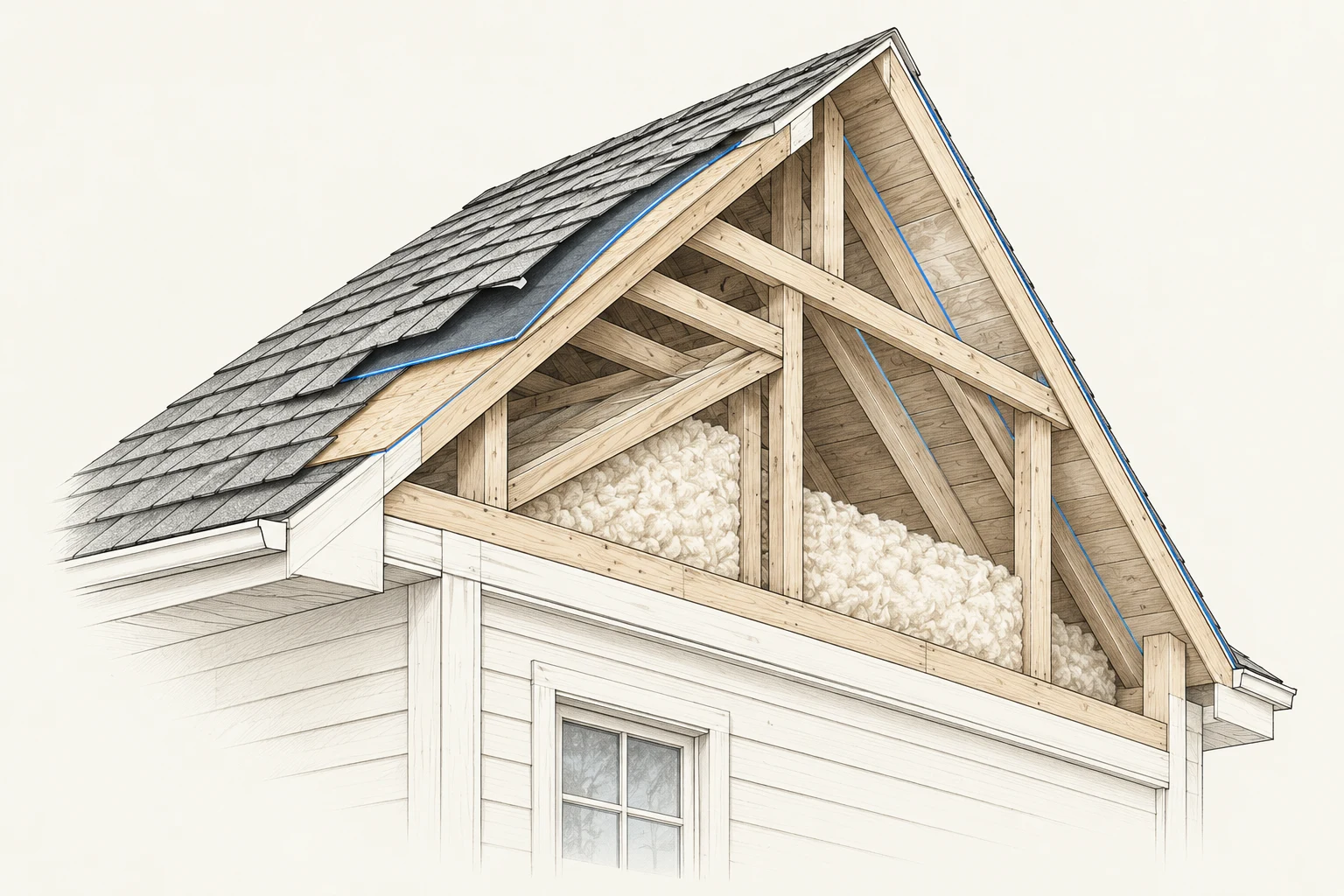
Conceptual architectural roof cutaway revealing shingles, timber rafters and insulation.
Conceptual roof section, not a condition diagnosis or a measured construction plan.
  1. 1

    Repair funding

    Where does cash come from before closing?

  2. 2

    Work and verification

    Who completes the required work, and when?

  3. 3

    Eligible purchase financing

    Can this borrower and property meet the proposed loan requirements?

For a qualifying project, HUD's 203(k) can combine purchase and eligible rehabilitation, with a different funding sequence. A lender incentive alone does not repair the roof.

Return to our $100,000 house. Until now, we have assumed it is sound.

Change that assumption. Imagine that it needs a $15,000 roof repair before it can meet the requirements of the proposed loan. This is another hypothetical, not a claim about a particular lender or property.

The buyer's income may support the planned payments. The seller may accept the price. Yet the sequence fails: the work needs money before the purchase financing can proceed, while the buyer needs the financing to complete the purchase.

This is different from a lender finding the loan too small to earn enough. It calls for a different remedy.

A higher lender payment does not repair the roof. A lower purchase price does not necessarily put repair cash in the buyer's hands. A renovation-financing structure may address the timing, but only if the property, borrower, project and lender can meet its requirements.

FHA's Section 203(k) program provides one such structure, combining acquisition or refinancing with eligible rehabilitation in a single insured loan, with repair funds held and released through the rehabilitation process. It is not a promise that every inexpensive house or repair plan will qualify. HUD's 203(k) program description

The distinction between value and condition is equally important. An appraisal is not a substitute for a home inspection, as HUD's homebuyer guidance makes explicit. A lender's willingness to finance a house does not tell a household everything it needs to know about living in it. HUD: For Your Protection, Get a Home Inspection

Our original $532 payment can no longer carry the story. Repairs have their own cash needs and timing. Some costs are predictable enough to plan for; others appear after a wall is opened or a winter arrives.

The affordable purchase is the one a household can sustain, not merely the one it can close.

This gives us three separate tests. Can the household support the full cost? Can suitable financing be arranged? Is the property safe, usable and maintainable on those terms?

A low asking price answers none of them by itself.

Ownership rights

A payment is not
the whole ownership agreement.

Who holds legal title?

Ownership can follow different timetables.

Who pays for repairs?

A modest payment may carry larger obligations.

What follows a missed payment?

Examine remedies and the buyer’s accumulated stake.

Questions to investigate, not a universal description of legal protections. The agreement, jurisdiction and applicable law matter.

When another route changes the rights

If a conventional mortgage is difficult to obtain, an offer of seller financing can sound like someone finally removing the obstacle.

Sometimes an alternative structure may serve a useful purpose. But “no bank required” is a description of what is absent, not a complete description of what replaces it.

Under a contract for deed, the seller generally retains legal title until the buyer meets the contract's payment conditions. In its August 2024 report, the CFPB described risks including forfeiture provisions, title defects and buyers assuming expenses for homes with significant problems. Depending on the agreement and applicable law, losing the contract can put accumulated payments and improvements at risk. CFPB's contract-for-deed report

The bureau's separate 2024 advisory opinion on these arrangements was withdrawn on May 12, 2025. We should not present that opinion as current guidance. Withdrawal does not itself settle which existing federal or state protections apply to a particular transaction. CFPB's withdrawn-guidance register

This is not a judgment that every seller-financed transaction is abusive. It is a reason to examine the actual rights, costs and remedies rather than treating all routes to a front door as equivalent.

Who holds title? Who owes the taxes? Who must fix the heating? What happens after a missed payment? What remains of the buyer's accumulated stake if the arrangement ends? Those questions can matter more than an inviting first payment.

The deeper consequence of a missing mortgage is therefore not always a missing sale. The sale may still happen, through a structure that transfers a different bundle of rights and risks.

Counting the keys handed over will miss that difference.

An incentive aimed at the lender

Pay for the route.
Then measure who gains.

A reported program is evidence of activity. The additional opportunity still has to be evaluated.

Illinois / Access Plus / 2025 account$5,000

Flat servicing-release premium
to the participating lender

Eligible first mortgage balance ≤ $60,000
Reported buyers assisted207

A dated agency count, not a causal estimate of additional purchases.

Not a $5,000 buyer grant. Not confirmation of current availability.

Participating lenderReceives the premium
Eligible mortgageOriginal balance ≤ $60,000
BuyerEvaluate the added access
IHDA's 2025 program account. The hypothetical $3,000 payment in our experiment is separate from this reported $5,000 lender premium.

Illinois offers a concrete example of treating the production problem directly.

In its 2025 account of the Access Plus program, the Illinois Housing Development Authority described a flat $5,000 servicing-release premium paid to participating lenders for eligible first mortgages of $60,000 or less. The agency reported 207 buyers assisted and more than $8.8 million in mortgage volume in that snapshot. The lender payment was not the same thing as a $5,000 grant to the buyer. IHDA's 2025 program account

The design directs money toward the business deciding whether to originate the loan. That is different from helping a borrower make the down payment, even if a program also offers borrower assistance.

The reported results are an agency account, not proof that every one of those loans would have been absent without the incentive. They also do not establish current program availability. The next questions are evaluative: which transactions changed, on what terms, and how did the households fare afterward?

A count of supported loans is a useful starting point. It cannot tell us whether a subsidy reached otherwise excluded buyers or paid for transactions that would have occurred anyway. Nor can it tell us whether unexpected repairs later overwhelmed the household budget.

The economic experiment helps us understand what a flat payment might change. It cannot establish whether a specific program is well targeted.

That requires observation: comparable borrowers and homes, clear eligibility, the full cost to the household, and outcomes after the excitement of closing has passed.

An access policy should be judged by the opportunity it adds, not just the activity it pays for.

Public Law 119-101 / July 11, 2026

A new law
is not a loan offer.

  1. 01 / Enacted authorization

    Authorized.

    Section 105 says HUD may establish a small-dollar FHA pilot. Original balances ≤ $100,000; one-to-four-unit principal residences.

  2. 02 / Separate implementation

    Verify the program.

    Authorization does not establish an operational pilot, its terms or participating lenders.

  3. 03 / Individual availability

    Check the actual offer.

    A household still needs to verify lender participation, eligibility, property requirements and full costs.

Enacted law, §§105 and 402. Section 402's separate points-and-fees evaluation is not an automatic fee-rule change. Evidence checked October 6, 2026.

A new law is not a loan offer

The 21st Century ROAD to Housing Act became Public Law 119-101 on July 11, 2026. Section 105 authorizes HUD, acting through the Federal Housing Commissioner, to establish a small-dollar FHA pilot. Options include payments to lenders and assistance with borrower transaction costs. Its definition covers original balances of $100,000 or less, secured by one-to-four-unit principal residences. The section says HUD may establish the pilot; it does not itself provide an operational loan offer. Enacted law, Section 105

Section 402 directs an evaluation of how certain regulatory points-and-fees thresholds affect originations, within 270 days of enactment. Its definition uses balances below $100,000. That provision is an evaluation requirement, not an automatic increase in allowable fees. Enacted law, Section 402

These are important distinctions for readers encountering optimistic headlines. Authorization, implementation and availability to an individual household are different stages. The statute alone cannot tell someone where to apply tomorrow.

Definitions also move between studies and programs. A home price below $150,000 in the Pew chart is not a loan balance below $100,000 in the law. Neither is the $60,000 balance threshold in IHDA's reported program. Our $100,000 house required an $80,000 mortgage because we assumed a down payment. Mixing those quantities makes comparisons look cleaner than they are.

The near-term news cycle is turning toward this issue: Realtor.com's October 5 research preview scheduled a small-mortgage regulatory report for October 7. That forthcoming report was not available for this article's October 6 evidence check, so its findings are not used here. Dated research preview

We already have enough evidence to identify the question. What remains to be demonstrated is which changes can reliably bring sound, affordable purchases within reach.

The way in

An entry-level home
needs an entry.

Price. Payment. Process.
Condition. Rights.

Follow the whole route
The folded-paper house and processing file, reunited at the conclusion.

There is a way to simplify this story badly: say that lenders should make every small mortgage. There is another: say that the market has spoken, so any transaction it declines must be unsuitable.

Both avoid the work of finding out what failed.

If the obstacle is unnecessary duplicate processing, remove the duplication. If it is a real fixed cost that society has a reason to support, decide transparently who should pay it. If it is an uninhabitable property, address the property. If it is a payment the household cannot sustain, calling the loan “access” will not make the burden disappear.

Technology belongs in that diagnosis, not above it. Reusing verified information might reduce repeated effort. Better triage might get unusual files to the right specialist sooner. But a cheaper process is not an improvement if it achieves its savings by overlooking a title defect, misreading a thin market or failing to understand a repair requirement.

The test is whether it preserves the job the expensive step was meant to do.

And the measurement should begin before the application form. A household discouraged by a lender's minimum balance may never appear in a denial statistic. A home sold for cash may never reveal the financed offer that could not be made. A program serving people who were already likely to buy may look productive while adding little access.

We need to distinguish transactions counted from opportunities created.

For a prospective buyer, this means asking about the actual loan size, property requirements, repair financing and total cash to close early, rather than waiting until a listing feels like a home. Where suitable offers exist, comparable Loan Estimates are more useful than comparing the advertised rate alone. CFPB's Loan Estimate guide

For policymakers and lenders, the test extends past the purchase. Did the household get sound financing? Could it maintain the home? Did the terms preserve a meaningful ownership stake? Could the model continue serving similar buyers without permanent uncertainty over its funding?

Those questions cannot be compressed into a single origination count. They can guide a better system.

Return, finally, to the $100,000 house. The small payment was never the whole promise. It was one part of a possible purchase, resting on a set of assumptions about work, money, condition and rights.

An entry-level home needs an entry.

Until that route exists, the price on the listing is only the beginning of the story.

Evidence and model notes

This article combines dated published research, official program documents and an illustrative economic model. It contains no invented interview, observed transaction or claim that Oftu has measured nationwide lender behavior. Historical findings are labeled with their periods; program authorization is distinguished from implementation. This is educational analysis, not a mortgage offer or individualized financial or legal advice.

The production experiment uses contribution = (revenue rate − variable-cost rate) × loan balance − fixed cost + lender incentive. With a positive percentage spread, the nonnegative-loan-balance break-even point is the larger of zero and (fixed cost − incentive) / spread. A zero or negative spread needs a separate state explanation, not an infinite or negative threshold displayed as a valid loan size. Values are assumed, not fitted to MBA's production-cost average.

The opening payment is calculated for an $80,000 principal, 7 percent annual fixed interest, monthly amortization and 360 payments: $532.24 before any other housing costs. No quoted current rate is implied.