
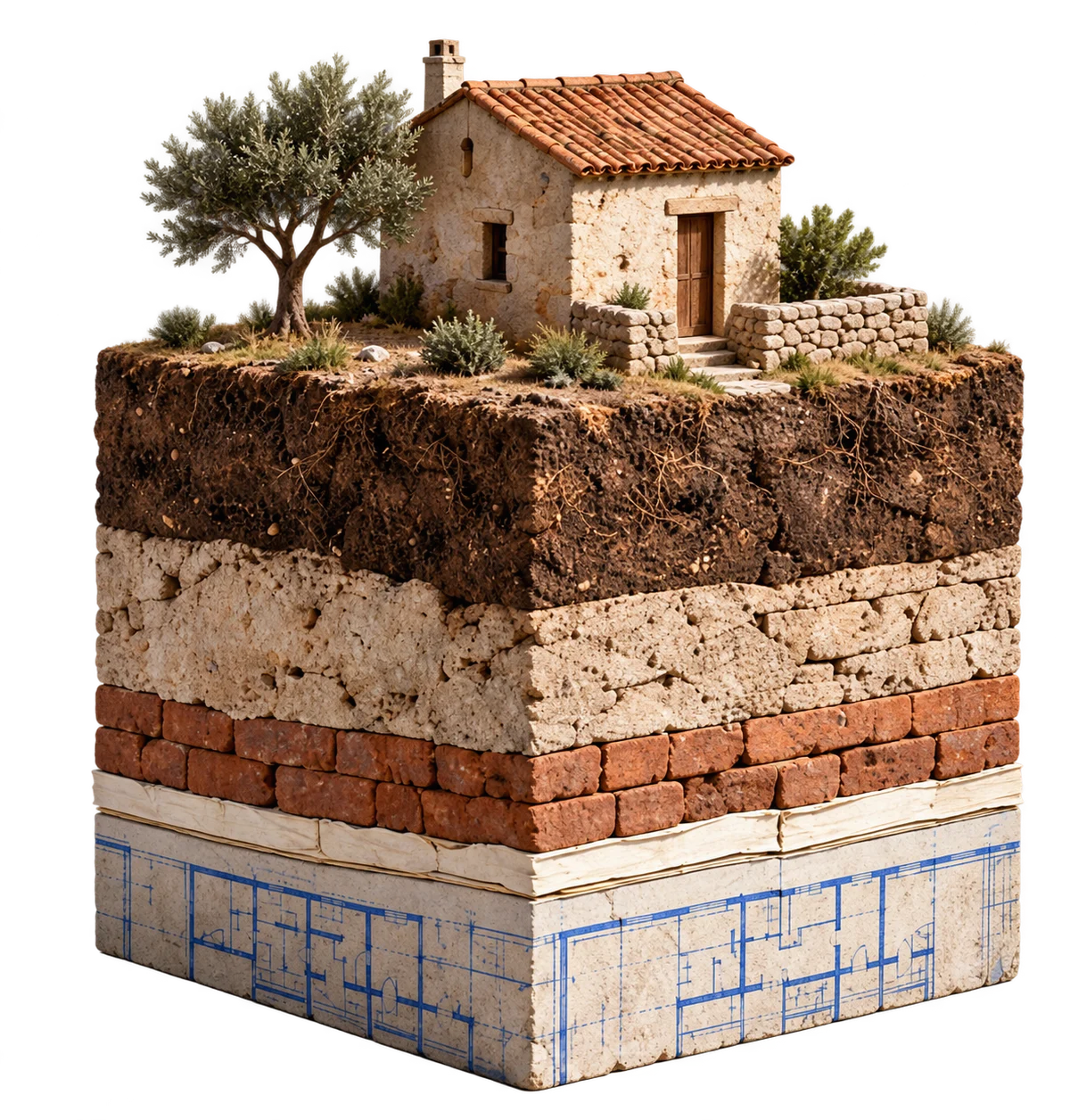
Act 01 / Earth
A place to remain
Shelter before the deed
Enter through the roof
The entrance is above you.
At Çatalhöyük, in what is now central Türkiye, houses were packed together so closely that you did not approach them along a conventional street. You crossed the roofs. A wooden ladder took you down into a room. The oven was near the ladder; raised platforms served domestic life and sleep. Some of the dead lay beneath those platforms. The excavation project's architectural account gives us the ladder, the oven, the plaster and the platforms. Their voices are missing.
Let the ladder slow you down.
We are used to reading a house from the outside: the front door, the windows, the number beside the entrance, the little rectangle on a map. Here that familiar reading fails. The way in crosses the surface we would call private. Below the floor, the division between domestic space and the place of the dead is not where we expect it. Above the room, movement depends on other rooms. A home can be intensely particular without resembling the detached object in a property listing.
On the eastern mound, UNESCO identifies eighteen layers of settlement dating from roughly 7400 to 6200 BCE. Houses were renewed over earlier houses; building and rebuilding helped raise the place itself. The long sequence is evidence of an effort to remain, accumulated beneath the feet of later occupants. It does not tell us that they used our categories of landlord, tenant or freeholder.
The walls are here; a deed is not. The absence of a deed does not prove the absence of rights. It means the excavated walls alone cannot tell us who was entitled to occupy, exclude, pass on or exchange them. We can enter without asking the occupants to become early versions of us.
Much later, other rooms will acquire documents. A scribe will press a rental agreement into clay. A court will decide whose promise counts. A survey will turn lived country into numbered parcels. A bank will advance money against a house that cannot move. Investors far from the street will acquire claims on the payments made by people inside it.
None of those transformations will remove the original task. Someone still needs a dry place to sleep.
This is a history of what gathered around that task. Not a complete atlas of every housing culture, and not a race to award a civilization the first house, the first owner or the first landlord. The surviving record cannot support that race. We will visit selected places where the relationship between shelter and power becomes unusually visible. The route moves between regions and occasionally doubles back in time, because a new way of owning in one place can coexist with an older, or simply different, arrangement elsewhere.
The question guiding us is smaller than the world, and large enough for a lifetime: how did a place to live become something that could be inherited, rented, fenced, taxed, mortgaged, securitized, protected, lost and fought over?
To answer it, we have to start before the documents.
Before the field
A house does not need a wheat field beside it to become a house.
At Ohalo II, beside the Sea of Galilee, researchers found the remains of a fisher-hunter-gatherer camp occupied around 23,000 years ago. Brush huts, plant remains and successive floor deposits survived with unusual richness. A 2022 study examines the animal remains across three floors of one hut. People were making organized domestic places thousands of years before the farming villages that often open popular accounts of housing. This is evidence of a particular camp, not humanity's first home.
Imagine two shelters built at the same time. One is made of stone, the other of branches. The stone survives, the branches rot. Thousands of years later, an account of architecture begins with the stone. What appears to be the beginning of an idea may be the beginning of its preservation. The archive has materials it likes.
Water, in this instance, changed the odds. Inundation helped preserve a domestic world that would ordinarily have disappeared; falling lake levels exposed it for study. Frank Hole's 2004 discussion of the Ohalo bedding finds describes that unlikely sequence. What appears to us as an ancient beginning depends partly on a lake choosing what to keep.
What survives is enough to unsettle a familiar sequence: first farming, then settlement, then the house, then property. Some parts of that sequence describe important changes in particular places. It is not a universal itinerary that every society had to complete.
Shelter can be made for a night, a season or a return. Its importance is not measured only by the number of years a wall stands. A temporary dwelling can organize a life. A repeatedly used place can hold memory even when the structure is remade. Mobility and attachment are not opposites as cleanly separated as a modern address form suggests.
The words real estate encourage us to start with the fixed object. A parcel stays put. A building has coordinates. The questions faced by an occupant extend past those coordinates: where can we live, what can we reach from here, who can stay with us, and what happens when we leave?
Those questions precede a purchase price. They also outlast it.
A house changes the terms on which a body meets the world. There is a place to put things down, to organize work, to gather, to withdraw. The pattern of domestic remains tells us that life was being structured in space. It does not tell us what an individual occupant felt upon returning. We can leave that voice missing without making the room less important.
The more revealing question is why the desire to return becomes, in some settings, an obligation to remain. Once substantial labor is invested in a place, moving means abandoning something. Once a household's stores, work and relationships are arranged around it, displacement can cost far more than the structure. The building is only the part we can most easily count.
We will encounter this difference repeatedly. A city planner may count demolished rooms. A lender may count collateral. A family may lose the route by which care, work and ordinary errands were possible. The quantities describe the same event without measuring the same loss.
Before we learn how a home became an asset, we need to leave room for the things that never fit comfortably on its balance sheet.
The house remembers
Return to the mound.
At Çatalhöyük, the architecture was not simply replaced and forgotten. Houses were filled, renewed and built upon. Mudbrick and plaster belonged to a cycle of maintenance; a domestic surface could be both the end of one room and the beginning of another. The excavation project's description of architecture records this process. The ground was, in part, the residue of living there.
For a modern buyer, age is often a defect to investigate or a charm to advertise. Here it is something else: an accumulation of location. A place becomes higher because people keep making it habitable. The distinction between building and ground is less stable than our vocabulary allows.
It is tempting to turn that continuity into a story of an unbroken family, but the archaeological record does not let us write a genealogy merely because walls stand on earlier walls. Continuity of place is not automatically continuity of household. Nor does similar architecture prove equal power. The houses deserve close attention precisely because they do not answer every question at once.
Consider the labor of a surface. A plastered wall is an object, but it is also a task performed and performed again. A floor that remains useful has been cared for. When we speak about the value of housing as though it were lodged permanently in the bricks, we lose the ongoing work that keeps the bricks useful.
Maintenance will rarely receive the glamour of invention in this history. It has no single dramatic date. Yet a dwelling without it steadily becomes something other than a dwelling. An elegant financing arrangement cannot repair a roof by itself. A legal right to occupy an unsafe room may be better than arbitrary eviction, but it does not make the room safe.
This is one reason to resist treating property history as a series of increasingly sophisticated documents. Institutions matter enormously. So do the people who carry water, mend walls, clear drains and make another year of occupation possible. Some are paid; some are not. Their work often disappears into the word home.
The roof entrance offers another lesson. The private room and the shared route are physically connected. The whole settlement cannot be understood by inspecting one interior. A dwelling's usefulness depends on arrangements that extend beyond it.
The roof route has a familiar difficulty without being the ancestor of a modern apartment corridor. People can have a space of their own while depending on common passage, services and rules. The map of ownership and the map of dependence will seldom match.
Elsewhere, that dependence is visible in infrastructure rather than rooftops. At Mohenjo-daro, an Indus city flourishing in the third millennium BCE, the surviving urban fabric includes planned streets and drainage. UNESCO's site description records an organized city whose services crossed the boundaries of individual rooms.
A drain is an excellent corrective to the isolated-house story. Waste leaves one room and enters a network. The quality of a private interior depends on what happens outside it. A household cannot solve every problem by closing its door.
Much later, in southern Africa, the stone enclosures of Great Zimbabwe would contain another arrangement of domestic space. The site developed between the eleventh and fifteenth centuries. Within its Great Enclosure stood living quarters made with daga, a mixture of granitic sand and clay. Walls marked family areas containing kitchens, living huts and courts. UNESCO's description of the surviving architecture distinguishes the imposing stone boundary from the dwellings within it.
The wall that most readily attracts a photograph was not, by itself, the home.
Look inward from the monument and the scale changes. A household needs places for tasks, movement and company, not merely an impressive perimeter. The surviving enclosure can dominate our imagination while the more vulnerable materials of daily life require closer attention. The problem we met beside the lake returns: the part that lasts longest can become the part to which history gives the most importance.
These settlements are separated by immense distances and periods. They offer no single blueprint of ancient domestic life. They do give us a reason to distrust a history drawn entirely around the freestanding rectangular house. A room, a courtyard, a route and a boundary can be assembled in arrangements that our familiar property diagram would struggle to contain.
We have already met two distinct sources of housing value: the work invested in a place and the arrangements that allow many places to function together. Later owners will be able to claim some of the resulting value as their own. That claim may be lawful. Its existence will not mean they produced every part of it alone.
The next step is to examine how claims become legible enough to survive an argument.
For that, leave the buildings and pick up a small piece of clay.
Act 02 / Ink
The claims around a room
Promises, rights and recognition
A room becomes a sentence
The object is smaller than a modern phone.
The Metropolitan Museum of Art holds a clay tablet catalogued as a house rental contract from the archive of Iddin-Nabu and Shellebi. It dates to about 514 BCE and probably comes from Babylon. Its face measures approximately 5.2 by 6.5 centimeters. The museum's record gives an agreement, an archive and a place. The catalog does not tell us enough to reconstruct the rent or the negotiating conversation.
The modest size is part of its force. A relationship large enough to govern where someone lived could be carried in a hand.
By then, recording property transactions had a very long history. A University of Chicago catalogue describes the so-called Chicago Stone, a Sumerian record from around 2600 BCE of several field purchases, probably assembled for one unnamed buyer. Payment included silver and commodities. The same catalogue describes Old Babylonian domestic archives, from roughly 2000 to 1600 BCE, containing evidence of property held, sold, rented and inherited. Scribes helped make agreements readable and durable. Some tablets included plans identifying claims to particular rooms. The catalogue's discussion of land and property is a useful starting point, not evidence that every Mesopotamian household could trade freely on identical terms.
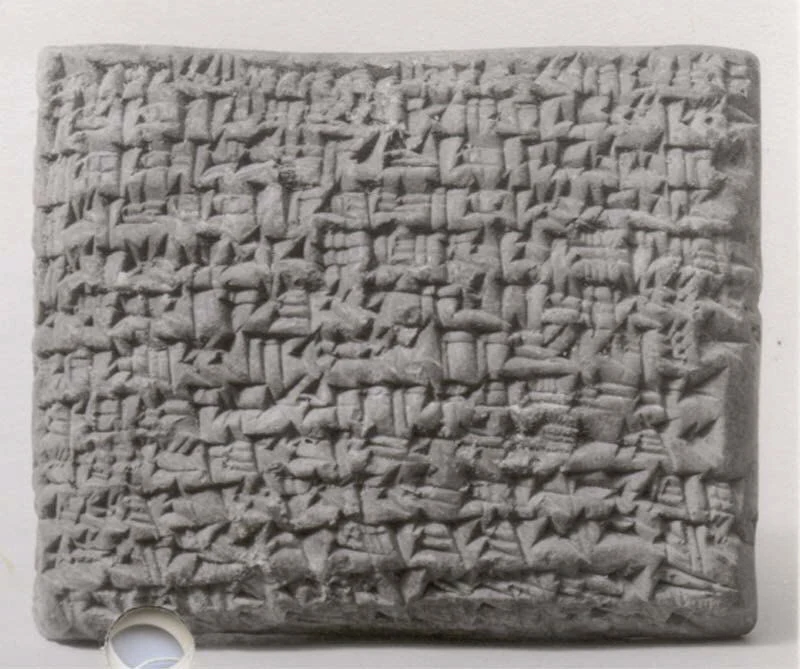
A room.
A promise.
A piece of clay.
A house rental contract from the archive of Iddin-Nabu and Shellebi. Babylonia, ca. 514 BCE.
- Object
- 86.11.153
- Size
- 5.2 × 6.5 × 2.5 cm
Public-domain image, The Metropolitan Museum of Art. This photograph is documentary evidence, not generated artwork.
A transaction is a more difficult object than a house. You can point to a wall. You cannot point to last year's promise in quite the same way.
A document gives the promise an address outside the memory of either party. It can name people, identify land, record obligations and preserve evidence for a future dispute. It helps a relationship travel through time. The person who recalls the agreement may die; the person who succeeds them can still confront the record.
This makes property more powerful. It can also make the ability to interpret records more powerful. If a household needs a scribe to understand the agreement, the document is not self-executing equality. Someone must know how to read it, someone must recognize it, and someone must have the authority to decide what happens when its terms are contested.
The little tablet sits inside a much larger social apparatus.
It is easy to describe writing as the moment when uncertainty disappears. In practice, records relocate uncertainty. Which document is valid? Was consent genuine? Whose account was written down? What did a term mean? Who can afford to challenge it? A record can settle a question and preserve a dispute at the same time.
The house plan is particularly intimate. We tend to think of inheritance as arithmetic performed after a death: a fraction here, a fraction there. In a dwelling, the fraction has to become usable space. A right to part of a room is not yet a convenient way to cook, enter or sleep. Legal division and physical division need not cooperate.
Where a house is partitioned, the law can acquire a visible form. A new doorway changes whose route passes through whose life. A wall can turn one domestic arrangement into two. Architecture is not only the setting in which rights are exercised; it can be altered to make those rights possible.
The long life of a claim begins to show itself here. A home can remain standing while the relationship to it changes. Someone rents rather than owns. Someone inherits a share rather than the whole. A household becomes two households. The same earth and walls support a different set of sentences.
Rental adds a further separation. The right to use a place can be detached, for a time, from the right to dispose of it. A person may have a home without being able to sell it. Another may receive income from a room they do not inhabit. What looks like one object from the street becomes several relationships in the archive.
The Babylonian tablet belongs to its own institutions and economy. Its modest size nevertheless makes a recognizable difficulty visible: shelter must be occupied now, while claims on it reach beyond the present occupant.
The document survives because its material is durable. The living arrangement it governed has vanished. We are left holding the part that could be archived.
That imbalance should stay with us. A history built only from transactions can make housing look as though its most important moments occur when ownership changes. Most of the time, its importance lies in what happens between transactions.
A city that could burn
In Plutarch's account, Crassus saw opportunity where other people saw a building in danger.
He acquired enslaved architects and builders, then bought houses on fire and houses beside them at prices frightened owners would accept. He also bought property confiscated from people killed under Sulla. Plutarch was writing long after the events, and his portrait is a moral judgment on a powerful man, not an audited property portfolio. The famous retelling in which Crassus refuses to extinguish a fire until the owner sells is not what this passage actually says. The less embellished account is disturbing enough. Plutarch's Life of Crassus places acquisition, calamity and political violence together.
The fire puts buyer and seller on different clocks.
A building threatened by fire does not give its owner a leisurely marketing period. A person with money and the capacity to repair may be able to wait for a future that the current owner cannot afford to reach. The price can fall because the need for cash becomes urgent, not because the ground has ceased to matter.
Sometimes a purchaser supplies the means to repair a damaged place. Sometimes urgency lets a stronger party take advantage of a weaker one. A transaction alone tells us that the property changed hands. The circumstances tell us how much choice each side had.
And in this case, the labor behind the apparent business acumen was enslaved labor. It would be grotesque to turn the account into an admiring lesson about building a property empire while moving those people out of the frame. They were treated as assets in the same economy that traded the buildings. The language of an investment can conceal the conditions under which it was made.
At Pompeii, a quieter arrangement survives in the buildings associated with Julia Felix: residential space, gardens, a bathhouse and shops. The archaeological park describes shops rented along the Via dell'Abbondanza and a private bathing facility opened to customers. Its account of the complex gives us a mixture of living space and income-producing uses. The park speaks in an imagined first person; Julia has not left us a diary to quote.
The building does not fit neatly into residential or commercial. A house can be a place to live and a means of earning. The modern separation of home from workplace is not a definition we can carry backward without checking.
The law could also divide claims in ways more subtle than a sale or lease. In Justinian's Institutes, compiled in the sixth century CE, a usufruct separates the use and proceeds of a thing from its underlying ownership, subject to preserving its substance. The text discusses leaving one person the usufruct and another the remaining ownership. It also recognizes arrangements concerning passage, water and a neighbor's light. Book II of the Institutes makes the separation explicit.
Do not let the unfamiliar word make the idea remote. Several people can have legally distinct relationships to one place. The person benefiting from it now need not be the person with the claim that remains afterward. A neighbor may be entitled to something across a boundary without becoming the owner of the land beyond it.
There is no single key that unlocks every right.
That realization changes how we look at an old city. The masonry is visible. The permissions, obligations and competing interests are not. A street can be lined with apparently solid buildings while the claims on them form a shifting, less visible architecture.
When we leave Rome, keep that invisible architecture in mind. It will help us read a kingdom's survey, then a field that looks open, and understand why a new entry or a hedge can change far more than the view.
The land that asked for service
The survey asks who held the land before the conquest, and who holds it now.
Domesday, the great record made after William's conquest of England, was concerned with change as well as possession. Royal commissioners gathered answers through sworn local inquiries. They asked about the land in the time of Edward the Confessor, at its grant under William and in 1086. They counted plough teams, woodland, meadows, mills and fisheries. They also recorded people in different statuses, including enslaved people, and asked what the whole had been worth and was worth now. The National Archives' guide to the record describes a kingdom made legible through recurring questions.
A change of ruler could be read in a change of names.
The land had remained where it was. The people entitled to command it had not. A page could record both the resources of a place and the rearrangement of power over them. The questions about value sat beside questions about who had gained, who had lost and what kind of person was being counted.
This is not a modern list of properties offered for sale. The record belongs to the administration of a conquered kingdom. Yet it contains a habit that will recur whenever property becomes a source of public revenue: authority wants an account of what can be required from the ground.
The chain of landholding made that account more complicated than one sovereign standing opposite one owner. A person might hold from someone who held from someone else. Service and payment were attached to relationships within the hierarchy. To describe an estate only by its acreage would leave its obligations out of the picture.
Magna Carta makes those obligations visible in unusually direct language. The 1215 charter's second clause concerned heirs of earls, barons and others holding directly from the king by military service. It set limits on the relief, the payment due upon inheritance: £100 for a whole barony and at most 100 shillings for a whole knight's fee. The clause's Latin and modern translation show succession being governed by a payment as well as a family relationship.
An inheritance could carry a bill.
The land therefore arranged relationships among generations and ranks. A death changed who could act, but it could also create an opportunity for the authority above the heir to demand money. Defining a limit on that demand was a struggle over power embedded in property. The estate's future was partly decided by rules about the moment when its holder died.
Another clause brought that struggle into a particular room. A widow was to receive her marriage portion and inheritance without payment for those rights. She could remain in her husband's house for forty days while her dower was assigned. Clause seven turns succession into a domestic interval: a bereavement, a right to stay, a deadline for making another arrangement.
Forty days is short enough to feel.
The clause is concerned with a widow in this landholding order, not a universal guarantee that every woman could keep any home indefinitely. Its importance is more specific. Property law had to confront the gap between the loss of a person and the assignment of the rights that would follow. The household could not stop needing shelter while the legal arrangements caught up.
The following clause gave a widow protection against being compelled to marry while she wished to remain unmarried. It also required consent from the king or relevant lord before remarriage. Those terms placed a protection and a restriction next to each other. Reading only the first half would turn a conditional liberty into a freedom the document did not grant.
The person, the marriage and the land were entangled. A new marriage could change the connections around an estate; authority over land could reach into an apparently intimate decision. The boundary between a private household and public power was not drawn at the front door.
Asking whether a holder was rich leaves much of this arrangement unexplained. From whom did they hold? What did they owe? What happened at death, and who could interrupt the next transfer? Wealth, possession and independence could be distributed differently within the same estate.
The famous charter is often remembered at the scale of constitutional principle. At the scale of a dwelling, it also shows the difficulty of protecting a person during a change in the claim that permits them to remain. Later centuries will devise other answers. The difficulty itself is already in the room.
A survey can count the productive resources of a place. A charter can regulate obligations higher in the hierarchy. Neither exhausts the relationships through which people make a living from the land.
To find some of the missing claims, walk out of the house and into a field that has no enclosing hedge.
The owner is not one person
An open field can look empty to someone who does not know how to read it.
There may be rights there: to graze particular animals, to take wood for domestic use, to cut peat for fuel, to fish. The National Archives' guide to English common land lists these historical rights and the limitations that often governed them. Quantities and seasons could be specified. A common was not necessarily land without an owner, and common rights were not a promise that anyone could do anything there. The archival guide describes a regulated landscape of overlapping uses.
An observer who asks only whose name is on the land misses who depends on it.
Take fuel. A right to gather it is not a decorative tradition. It can affect whether a household must spend scarce cash to stay warm or cook. A grazing right can support an animal, and the animal can support a household. If such a right disappears, a person may not lose a house or a separately owned field. They can still lose part of the economic arrangement that made living there possible.
The owner is not the whole story.
The room stays still. The selected claim changes.
Who may live here?
An occupant's right to use a room can differ from the underlying owner's interest. Duration, duties and protection depend on the arrangement.
The conditions that let a household remain could lie well beyond its threshold.
England's enclosure was a long, uneven process, not one morning on which a country acquired fences. Parliamentary history traces enclosure back to medieval practice and describes its increasingly formal authorization through legislation. Between 1604 and 1914, more than 5,200 enclosure bills concerned about 6.8 million acres, just over a fifth of England. Consolidated holdings could improve agricultural organization and production. They could also replace an older pattern of strips and shared uses. Historians disagree about how much enclosure, rather than other changes, drove poorer rural people into towns. Parliament's account is clear about both the scale and that disagreement.
We should not turn uncertainty about one causal question into uncertainty about whether rights changed. They did. Nor should we treat a gain in output as a complete account of who gained.
A field can become more productive while a particular household becomes less secure. The two statements are not contradictory. They use different measures and different units of experience. Total production, an owner's rental income and a laborer's ability to remain in a village do not rise and fall as one number.
The fence helps us understand a broader temptation in property history: simplification. Consolidating scattered interests can make land easier to administer. It can make improvement easier to coordinate. It can also make it easier to overlook a claim that was useful but awkward to express in the new system.
There is a practical argument for clarity. A person investing in a building wants to know what they are permitted to do and whether someone else can defeat their claim. A lender wants to know what can be recovered. A buyer wants an answer that will not dissolve after the purchase.
There is also a practical argument for taking complexity seriously. If clarity is achieved by discarding the rights of people who already use the place, the resulting certainty has been purchased by someone else's insecurity.
The difficult work is not to choose between perfect simplicity and a picturesque tangle. It is to decide which relationships deserve protection, how they can be recorded, and whose consent is required when they change. A beautiful cadastral map does not answer those questions merely by being beautiful.
The common introduces another possibility. Property can arrange use without requiring that each useful relationship be packaged as an independently saleable object. That possibility never vanishes from the world, even where markets become powerful. It returns in cooperatives, trusts, long leases and public space, each with its own rules and limitations.
The next institution makes a different choice. It asks whether an income-producing property can be made to serve a purpose that outlives the person who set it aside.
A house for someone not yet born
In Tabriz, a document described how property should support the continued work of a place of learning.
The deed of the Rab'i Rashidi endowment recorded an academic complex, its administration and its budget. Land across a broad region was attached to its support. UNESCO's account describes a library, teaching hospital, paper production and other functions, including the copying of works to protect them from destruction. This was a waqf: an endowment directing property toward a specified purpose. The surviving deed's UNESCO record gives us a particularly elaborate example. It is evidence of a design, not proof that every obligation was fulfilled forever.
Here the future appears in a different form from an inheritance.
A bequest may ask who comes after an owner. An endowment can ask what work should continue after them. It can attach income to people who have not yet arrived: students, patients, travelers, people in need. The property becomes a means of maintaining a recurring activity rather than a prize passed intact to one successor.
This is still an economic arrangement. A charitable purpose does not exempt a building from wear, a tenant from difficulty paying, or an administrator from the temptation to misuse funds. The document must somehow join an enduring intention to changing circumstances. The more distant the founder becomes, the harder it can be to interpret what fidelity requires.
That is part of the history, not a reason to dismiss the idea.
In early Ottoman Bursa, endowments shaped the growth of the city. Complexes called külliyes joined religious, educational and social facilities. Houses gathered around them. Rural resources supported urban institutions; UNESCO identifies Cumalıkızık as a village whose income supported the Orhan Ghazi complex. The World Heritage account of Bursa and Cumalıkızık describes infrastructure and institutions helping establish neighborhoods, not merely filling gaps after private development had finished.
The order is instructive. A settlement can grow around a commitment to shared services. A rent or agricultural income can be directed to a kitchen or school. The city is assembled through the destination of its revenues as well as the placement of its buildings.
We usually ask what a property yields. This history asks a second question: to whom, and for what?
Two otherwise similar buildings can send their income into very different futures. One may support an owner's consumption, another repay a loan, another sustain an institution. The cash flow is not an explanation until we understand the claim that governs it.
This also complicates the sharp division between property as a private good and property as a public concern. An endowment is neither an ownerless space nor simply a modern government department in historical costume. It has its own legal and administrative life. Its purpose may be generous, its management contested, its effects uneven. We gain more by examining those arrangements than by forcing them into today's two boxes.
There is a quiet reversal here. In the Crassus story, another person's urgent need creates an opportunity for acquisition. In the endowment deed, acquisition is meant to create a resource for needs that will recur. Both belong to the history of property. Neither is the whole of it.
The little rental tablet preserved an agreement beyond the memory of its participants. The endowment tries to preserve a purpose beyond the founder's life. Both face the same condition: a future person must recognize what the document asks.
But recognition is never distributed evenly. To understand whose intentions became enforceable, we need to look at the people the law allowed to act in their own names.
The woman the deed could not see
An English statute of 1882 contains a sentence that should make a reader pause: a married woman could acquire, hold and dispose of property as her separate property, without a trustee, as though she were unmarried.
The law also addressed her ability to contract and sue in relation to that property. The original Married Women's Property Act is not only a housing document. Its reach makes the point more clearly. The question was whether a person inside a marriage could be recognized as an independent economic actor.
Earlier reform had already begun. The 1870 act protected earnings and certain property; the 1882 legislation extended the change. Prior arrangements could also protect separate interests through trusts and settlements. Parliament's history of marriage and property describes the statutory progression. The story is not that every English woman before 1882 owned nothing, then everyone became equal in one stroke. Legal status, marital status and the means to arrange protection mattered.
The distinction between living in a house and controlling a claim to it can become brutally important within a household. The front door does not tell us who can make a binding decision, whose income is recognized, who can sell, or who can seek a remedy. Describing a property as family-owned can conceal an unequal distribution of authority among the people called the family.
This is a useful place to break the chronology.
In Aotearoa New Zealand, traditional Māori land and resource rights did not simply reproduce English coverture. Te Ara describes inheritance through both parents to male and female children, and married women retaining land independently of their husbands. It also describes connections between ancestral rights and continuing occupation, known as ahi kā, a lit or continuing fire. These are broad descriptions of customary arrangements, not a claim that all iwi and hapū practiced one unchanging code. The account of Māori inheritance makes the contrast possible without turning it into a ranking of entire societies.
The comparison removes a false destination from the map. History is not a line in which every community waits to arrive at the freedoms first discovered by nineteenth-century Europe. A legal reform can be momentous in its own setting without being humanity's first recognition of the underlying possibility.
It also shows why a supposedly neutral change of legal system can affect women as well as land. If a new system recognizes different people, different kinds of claim or different routes of succession, it can alter authority that existed before the change. Translating a right is not always the same as preserving it.
The domestic scene becomes clearer once we separate three questions. Can someone use a place? Can they control or transfer an interest in it? Will a court recognize them as the person entitled to act? These questions may have different answers. One person can spend a lifetime making a home while having little formal power over its future.
The statute's phrase about acting as though unmarried reveals the obstacle it was trying to remove. Marriage was not merely a private relationship added to an otherwise complete owner. It changed legal capacity. The reform had to alter the status of the person for the property right to work differently.
No survey of square footage would register that change. The building could look exactly the same afterward.
We have seen walls rearranged by inheritance and income redirected by endowment. Here the important renovation is in the law's recognition of an occupant. Some of the largest changes in real estate have occurred without a brick being moved.
A line across inhabited ground
The straight line looks innocent.
On a survey, it separates one parcel from another. In a register, it helps attach a name to a place. For a buyer, that clarity can be a relief. The alternative may be an expensive search through old transactions, uncertain boundaries and claims that appear only after money has changed hands.
In South Australia, the Real Property Act received assent on January 27, 1858. The system associated with Robert Torrens substituted registered title for much of the laborious investigation of chains of deeds. A central register and government-backed certificates were meant to make dealings faster, cheaper and more certain. The original legislation and its archival context describe a substantial administrative innovation, developed with influences and collaborators rather than conjured by one mind from nothing.
Certainty has real economic value. If a lender can establish who holds a recognized interest and whether another lender has priority, a transaction becomes easier to price. A purchaser need not repeat the entire investigation of the past. The register can make a claim portable without making the land itself move.
But there are two kinds of uncertainty here, and reducing one does not resolve the other. A register can make it clear whom the state recognizes. It cannot, by the act of being clear, prove that the state was entitled to erase every other relationship to the ground.
Cross the Tasman Sea and the cost of translation comes into view. Te Ara describes the early Native Land Court's practice, from 1865 to 1873, of placing no more than ten names on a title. Those named were supposed to stand for a wider group, yet the law treated them as owners with powers over the land. Later, listing all owners introduced different problems as interests fragmented through succession. The history of Māori inheritance under the court shows how an administrative form could change the meaning of a relationship it purported to record.
A form has a capacity. Ten spaces are not a neutral description of a community with more than ten people entitled to a say.
Nor is an individual name always an adequate translation of a collective relationship. The translation may create a person who can transact where no equivalent authority existed before. What looks, from the registry desk, like the simplification of ownership can look, from the community, like the manufacture of a power to sell.
Across the Pacific, a different legal machine was drawing its own lines. The United States Homestead Act of 1862 offered eligible claimants a route to title in surveyed public lands through residence and improvement. The National Archives preserves Daniel Freeman's application, proof and certificate for a 160-acre claim. Those documents are unusually concrete: a promise of opportunity became paperwork, occupation and a recognized parcel.
The phrase public land describes a legal category of the United States. It does not mean land without inhabitants, use, history or Indigenous claims. The promise of a beginning for one household could depend on a state declaring other relationships insufficient to stop it.
The Dawes Act of 1887 addressed reservation land held in common by imposing an allotment framework, subject to provisions and exceptions that changed through later legislation. Its text provided individual allotments, a period of federal trust and a route for disposing of remaining lands after allotment. The statute itself lets us see the machinery without pretending that one law explains every loss of Native land.
Homesteading, allotment, the Māori Land Court and Torrens registration were not the same institution. Their aims, jurisdictions and effects differed. The reason to place them beside each other is not to collapse them into a single accusation. It is to notice the decision that comes before a neat map: which claims will count as property, and which will be treated as an impediment to creating it?
Once that decision is made, later exchanges may appear ordinary. A buyer buys from someone recognized as a seller. A bank takes security from someone recognized as an owner. The violence or exclusion involved in producing that recognition may have disappeared from the transaction file.
A map can be exact and incomplete at the same time.
This is why the history of real estate cannot begin with the first recorded sale in a suburb and stop at the latest price. The chain of ownership is also a chain of recognition. At some point, someone had the authority to say that this kind of claim belonged in the register and that another kind did not.
The straight line is still useful. We should simply learn to ask what it has cut through.
Act 03 / Brick
A city enters the price
The work beyond the parcel
The city makes the location
Before a canal house could be desirable, the canal had to exist.
Amsterdam's seventeenth-century expansion made new urban ground. Canals were dug, land was raised, older structures were removed and a planned city extended outward. The major western expansion began in 1613; an eastern extension followed in 1656. In the municipal archive's account, some regents used knowledge of the plans to buy land that the city would later need. Amsterdam's own history of the canal district makes the relationship between planning, information and private gain unusually visible.
Location was not merely discovered. It was produced.
A buyer of a finished canal house could admire a frontage, a route and an address. Behind those advantages stood excavation, engineering, political decisions and the labor of people who would never own that frontage. A city's collective work could appear in an individual building's sale price.
The same archive connects the wealth of canal residents to trade and plantation economies using enslaved labor. It also distinguishes grand canal housing from the more modest streets and working districts nearby. The elegant city was not a sealed European accomplishment, paid for only by ingenuity within its borders. Its money had routes as well as its waterways.
This changes the familiar phrase location, location, location. The phrase sounds as though the important fact is where a house happens to be. Sometimes the more important fact is who made that place valuable, who knew it would become valuable, and who was allowed to capture the change.
Three kinds of investment overlap here. Someone invests in the structure. Someone invests in the network around it. Someone acquires a claim before others know how the network will change. They may all profit from the same sale, but they have not done the same thing.
Public works can create enormous benefits. A bridge shortens journeys; drainage makes occupation possible; a transit line connects households to employment. Their cost has to be paid, and their value goes somewhere. If the public makes an address more useful, an owner may benefit without commissioning the improvement personally.
An apparently private asset is often a receipt for a much larger undertaking.
There is a second lesson in Amsterdam's made ground. A desirable location is not necessarily a permanent location in the economic sense. Trade routes change. Industries leave. Transport makes one journey easier and another obsolete. A neighborhood can retain its buildings while losing part of the network that once made them useful.
We can sketch this without inventing a forecast. Place the same house beside an imagined station, then close the station. The walls have not changed. The household's reachable world has. To insist that the value is entirely inside the building would be to ignore the reason many people wanted the building in the first place.
Real estate is immovable, but its surroundings are not.
For investors, this is both the attraction and the danger. They can acquire something that benefits from changes beyond their own labor. They can also discover that control over a parcel is not control over the forces supporting its price.
Amsterdam offers an unusually long record of this tension. It is time to follow those houses beyond the moment when their canal was new.
What three centuries cannot tell you
A beautiful house can outlive a beautiful investment story.
In a study published in 1997, Piet Eichholtz constructed a historical price index using transactions in buildings on Amsterdam's Herengracht between 1628 and 1973. The selected canal offered an unusually durable, consistently high-quality sample. The index was estimated in real terms, after accounting for inflation. Its 1973 level was only about twice the level of 1628, even though the postwar period had seen much stronger real gains. The original paper's abstract and methodological description establish the finding and the particular sample to which it belongs.
Let the interval register: 345 years.
The tempting conclusion would be that property was a poor investment. That conclusion would be as careless as the claim the study unsettles.
Three centuries of houses.
Two endpoints. Not the whole return.
A price index measures one part of return. A rented house may provide income. An occupied house provides housing services. Owners pay for repairs, administration, taxes, insurance and financing. They may improve the property, and they may acquire it with debt rather than entirely with their own money. An account of investment performance must reckon with these flows, not merely compare two sale prices.
The Herengracht finding is therefore neither an endorsement of every property investment nor a verdict against them all. It is a useful refusal of an easy myth: old, scarce and beautiful does not automatically mean relentless inflation-adjusted appreciation.
An elegant facade can survive long periods when its real price does little. The city can remain important while investors enter at very different moments. A long average can conceal episodes that would have felt intolerably long to someone who needed to sell.
We should be equally careful about the selection. This is a particular, prestigious canal in a particular city, not a global housing index. Its usefulness comes from the unusual continuity of its buildings. That same continuity makes it different from districts demolished, transformed, rebuilt or missing from the surviving transaction record.
For a household, the difference between price and return is more than a technical footnote. A family can gain years of useful occupation from a house whose real resale price barely changes. Another can enjoy a large paper gain while struggling to pay the monthly bills. Neither experience is captured completely by a line on a price chart.
For a landlord, rent is not profit simply because a tenant paid it. A roof can absorb several years of apparent income in one repair. An empty month has a different meaning from an occupied month. Financing can amplify a good outcome, but it cannot turn every gross receipt into wealth.
For a leveraged investor, the purchase price and timing can matter more than the long-run reputation of the asset. Debt fixes obligations while the asset's price remains open to revision. An index may eventually recover; a borrower may have to meet a payment before eventually arrives.
There is a reason to pause over this distinction in a history rather than leave it to a calculator. Real estate acquired the aura of permanence partly because its objects were permanent relative to many other things. Yet physical endurance, legal security, investment return and immediate liquidity are separate qualities. One can be present while another is missing.
The house may stand for centuries. Your obligation arrives on Tuesday.
In the figure, the two reported endpoints stand apart across their 345-year interval. There is no invented annual curve joining them. The gap leaves room for what the summary cannot recover: the changing fortunes, decisions and lives between the dots.
The air between the buildings
In London in the summer of 1858, the river forced itself into Parliament.
Heat and the polluted Thames produced the episode remembered as the Great Stink. The London Museum describes efforts to treat the curtains of the Palace of Westminster with lime and the rapid political response to the smell. The resulting sewer works, developed under Joseph Bazalgette, extended over years rather than appearing fully formed when the bill passed. The museum's account of 1858 and its history of the sewer system distinguish the dramatic summer from the long construction task.
The detail about the curtains is almost comic. Its implication is not. A problem affecting enormous numbers of people became harder for power to ignore when it entered power's own rooms.
The private interior had helped create the public crisis. Flush toilets could move waste out of a house while sending it into an inadequate urban system. A household improvement was not automatically a city improvement. The clean room and the foul river belonged to the same chain.
This is one of housing history's recurring reversals. An arrangement can work at the scale of a parcel and fail at the scale of a neighborhood. A rational choice by each occupant does not guarantee an acceptable result for everyone living downstream.
Follow the problem across the Atlantic and it becomes visible in air rather than water. In late nineteenth-century New York, tenement housing placed work, sleep and domestic life in crowded buildings with inadequate light, ventilation and services. Jacob Riis's photographs and writing helped bring those conditions before a broader public. The Library of Congress exhibition includes a Hell's Kitchen dwelling without interior windows or indoor plumbing, as well as records of workshops inside homes and petitions for children's play space.
The documents are powerful, but Riis is not a transparent window into the people he photographed. He brought the prejudices and moral judgments of his time, including distinctions between people he considered deserving and undeserving. His work belongs in the history of reform and in the history of who was permitted to represent the poor. The two histories do not cancel each other.
A photograph of a crowded room can show an arrangement the comfortable would prefer not to see. It cannot explain, by itself, every bargain and constraint that placed people there. Nor should a reform story make residents disappear once a reformer enters the frame.
What is clear is that housing quality extends beyond the right to stay. A legally secure room can still be dark, unsafe or difficult to ventilate. A property can produce rent while failing to provide conditions a city should accept. The marketability of a building and the adequacy of its rooms need not move together.
By 1916, New York was drawing another kind of boundary. Its Building Zone Resolution regulated uses, height, bulk, yards and courts. The adopted resolution, preserved with later amendments, describes a city divided into districts and a building constrained by rules outside its owner's wishes.
The property now had an invisible envelope.
A parcel on paper might have a certain width and depth. What could be built upon it depended on a larger decision about the street, neighboring buildings and permitted uses. The owner held an interest in the ground, not an unlimited right to fill every cubic meter above it.
Such rules can protect important things: light, separation from dangerous uses, a workable relationship between one building and the next. They can also constrain the creation of new homes. The historical existence of a public purpose does not settle every later rule's effects. A regulation has to be judged partly by what it prevents and partly by what it makes difficult to provide.
The missing air between buildings is therefore part of real estate. So are the pipes beneath the street, the legal envelope above the lot and the distance between a dwelling and useful work. If we draw only the parcel, we draw the asset more neatly than we draw the conditions that let someone live there.
There is another way to discover the limits of a building. Return briefly to London, before the sewers, and imagine not the smell entering a room but the room itself disappearing.
A surviving insurance policy, dated August 7, 1682, names Sir William Twisden and a house on the south side of the Barbican. James Sadler is recorded as the person in possession. The insured amount is £130. The paper is signed by Nicholas Barbon, whose Fire Office had been established in 1680. The London Museum's record of the actual document preserves the names, location and amount. It does not tell us everything about the relationship between those two men, or what either would have suffered if the house burned.
Notice what has happened to the danger. In the Roman account, fire helped the opportunistic buyer impose his price. Here, money is committed before the catastrophe, under a contract intended to address a possible loss. The building remains combustible. Its financial exposure can be arranged differently.
An insured sum is not another room, and compensation cannot return a destroyed household exactly as it was. But a house can now be discussed as a risk to be priced and shared, as well as a place to occupy. The named policyholder and the named occupant need not be the same person. Even protection raises the question we have been following: protection of what, and for whom?
From here, another invisible structure begins to take prominence. It is not beneath the road or above the roof.
It runs through time.
Act 04 / Paper
A home acquires a second life
Debt, access and distant investors
The loan learns to wait
A home costs money before it provides years of shelter. Credit is one way of crossing that gap.
The idea of pooling savings to help members obtain housing did not begin with the American thirty-year mortgage. In a 2025 historical introduction, the Bank of England traces building societies to Ketley's initiative in Birmingham in 1775, begun in a pub. The early society was temporary: it would wind itself up once its members were housed. The account of its origins describes a financial institution whose success could mean its own disappearance.
It is a bracing idea in a world accustomed to treating growth as an institution's proof of life. The members had a task to complete. Once it was done, the organization did not need to invent another reason to persist. Later permanent societies would make a different bargain, serving successive savers and borrowers rather than a single group.
The basic timing problem is easy to recognize. A household earns gradually; a building must be bought or built in a larger, earlier transaction. If savings can be gathered and lending organized, the household can occupy the house while meeting the cost over time.
A smaller payment.
A larger unfinished promise.
Same principal. Same fixed rate. Two different contracts, followed for their first five years.
Vertical scale: $0 at the bottom; $200,000 at the top gridline.
Inspect the payment schedule and method
Amortizing payment = P × r / (1 − (1 + r)−360), with monthly rate r = annual percent / 1200. At 0%, payment = P / 360. CSV and this table come from the same unrounded calculation.
| Month | Amortizing balance | Interest-only principal | Total interest-only due |
|---|---|---|---|
| 0 | $200,000.00 | $200,000.00 | $0.00 |
| 12 | $197,543.98 | $200,000.00 | $1,000.00 |
| 24 | $194,936.47 | $200,000.00 | $1,000.00 |
| 36 | $192,168.14 | $200,000.00 | $1,000.00 |
| 48 | $189,229.06 | $200,000.00 | $1,000.00 |
| 60 | $186,108.71 | $200,000.00 | $201,000.00 |
The arrangement is useful. Its usefulness does not make every version safe.
Before the mid-1930s, many US borrowers faced loans limited to around half a property's value, with terms of five to seven years and principal due in a balloon payment. The New York Fed's historical account of the contemporary mortgage describes those terms and the subsequent institutional change. Lending was varied; this is not a claim that every American mortgage followed one contract.
Under an interest-only balloon arrangement, a borrower could make every scheduled interest payment and still owe the original principal when the term ended. The household had been financing occupation, not gradually retiring the whole debt. At maturity, it needed cash, a sale or another loan.
This creates a danger distinct from missing the monthly payment. A person may have paid faithfully and still depend on a lender being willing to renew. If credit disappears when the balloon comes due, punctuality cannot manufacture the refinancing.
The Great Depression made these vulnerabilities painfully consequential. Housing distress, bank failures and falling values interacted with the problem of renewing short loans. Federal interventions helped restructure the system, including the Home Owners' Loan Corporation and the Federal Housing Administration. The St. Louis Fed's historical study of Depression-era mortgage distress distinguishes emergency refinancing from later changes to lending institutions.
Amortization changes the bargain. Part of each payment covers interest; part reduces principal. Over the agreed schedule, the loan is designed to disappear. Under a fixed rate, the contractual principal-and-interest payment can be stable even when new borrowers encounter very different rates.
That stability is a design achievement, not a natural property of a house. The walls do not produce the repayment schedule. Institutions and investors have to make long promises supportable.
Consider a deliberately invented example: a $200,000 loan at 6% annual interest. An interest-only version requires $1,000 a month before fees and other housing costs, with $200,000 still due at a five-year maturity. A fully amortizing thirty-year version requires about $1,199 a month in principal and interest. After five years, its balance is still roughly $186,100, but it has no contractual balloon at that point.
The difference is not that the longer loan makes housing free or quickly extinguishes the debt. The first years pay substantial interest. The difference is the scheduled obligation at year five: a large maturity event in one contract, an ordinary continuing payment in the other.
Our interactive study keeps the comparison on those terms. It holds principal and rate constant, lets you change them, and shows balances and scheduled payments. It does not reconstruct an actual 1930s household, include taxes or insurance, predict refinancing availability, or claim that every historic balloon loan was interest-only. It is a calculation designed to expose a mechanism.
There is another side to the stable promise. Someone financing a long fixed-rate loan may rely on money that must be renewed sooner or reprices faster. If the cost of funding rises while income from old loans stays fixed, the institution can be squeezed. The Federal Reserve's history of the savings and loan crisis places this exposure within a larger story of regulation, funding and increasingly risky activity.
Risk can be transferred without being abolished. A household protected from one kind of repricing may be connected to a financial system carrying it elsewhere. The important question is whether that system has the capital, funding and rules to carry the promise through bad conditions.
For a reader inside the house, this may feel distant. But a dependable payment schedule is one of the reasons a dwelling can become a dependable place to remain. Housing finance is architecture made from dates.
We must now ask who was allowed to enter the buildings that architecture made possible.
The door opens easier. For whom?
In 1930, J. D. Shelley, his wife and their six children moved from Mississippi to St. Louis, seeking to escape racial oppression in the South. They lived with relatives and then in rented homes. The National Park Service's account of the family and their house gives the purchase a history before it became a case: years of living somewhere without yet holding a home of their own.
On August 11, 1945, the family received a warranty deed to a house on Labadie Avenue. On October 9, other property owners asked a court to prevent them from taking possession and to strip them of title.
The obstacle was a racially restrictive agreement recorded in 1911. Its terms tried to exclude Black occupants from the covered properties. The Supreme Court's account says the Shelleys had no actual knowledge of the agreement when they bought. The dispute eventually reached the United States Supreme Court, which ruled in 1948 that state courts could not enforce such covenants consistently with the Fourteenth Amendment's equal-protection guarantee. The original opinion in Shelley v. Kraemer preserves the purchase, the attempted dispossession and the distinction between a private agreement and state enforcement.
It is worth slowing down at the deed.
More owners.
Not the same door for everyone.
Owner-occupied share of occupied housing units
Read all eleven observations
| Year | Owner-occupied share |
|---|---|
| 1900 | 46.5% |
| 1910 | 45.9% |
| 1920 | 45.6% |
| 1930 | 47.8% |
| 1940 | 43.6% |
| 1950 | 55.0% |
| 1960 | 61.9% |
| 1970 | 62.9% |
| 1980 | 64.4% |
| 1990 | 64.2% |
| 2000 | 66.2% |
The family had participated in the transaction the property system ordinarily recognizes. Someone had sold; they had bought; a document had conveyed a claim. Yet neighbors asked the legal system to make that purchase insufficient because of who the purchasers were.
The question was not whether the house could be used as a house. The question was who could live in it.
The ruling refused the state's judicial assistance in enforcing these racial restrictions. That mattered enormously. It left other barriers, contracts and conduct to be confronted; the family had won an indispensable decision, not an end to the struggle.
Housing finance had been making some doors easier to open while reinforcing barriers at others. The FHA insured loans originated by private lenders. Its underwriting practices incorporated racial discrimination, and its 1938 manual promoted racially restrictive occupancy covenants as a means of protecting property values. The Federal Reserve's historical account of redlining locates these choices within the new insurance system and the existing practices of lenders and real estate institutions.
A policy that reduces financing risk for one group can widen the distance to another group if access is unequal. The advantage is not confined to the first purchase. More favorable credit can affect what can be bought, how long an owner can remain, how much principal can be repaid and what may eventually be passed to children.
The consequences can accumulate through ordinary transactions. A discriminatory rule need not appear in every later deed for its earlier effects to matter. A household that could not acquire an asset at one moment does not acquire the missed years of ownership merely because a barrier is later removed.
The FHA and the Home Owners' Loan Corporation were different programs. Their maps, mandates and lending patterns should not be folded into one convenient name. A 2022 study by Fishback, Rose, Snowden and Storrs examined historic mortgage records in Baltimore, Peoria and Greensboro. It found that FHA exclusion predated the familiar HOLC maps; HOLC refinancing reached neighborhoods and Black homeowners largely excluded by the FHA. Their original research challenges a simple map-caused-everything account. The correction makes the machinery of exclusion more specific, not less consequential.
A century of national ownership numbers offers another kind of evidence. The Census Bureau's historical table records a US homeownership rate of 46.5% in 1900, 43.6% in 1940, 55.0% in 1950 and 66.2% in 2000. These decennial observations describe the share of occupied housing units occupied by owners. They are not percentages of people who owned a debt-free house.
The postwar rise is visible. Its cause is not printed inside the dots. Construction, incomes, demographics, credit, public policy and other changes belong to the explanation; the national series alone cannot allocate the contribution of each. It also cannot show how differently the opportunity was distributed among groups and places.
A rising national line can be true while an excluded household's story is also true. The aggregate does not invalidate the absence. Nor does an account of exclusion require us to deny the genuine expansion of ownership for millions of households.
The more revealing question is what the expansion was built from and whom its institutions served. Credit changed the distance between wages and a purchase price. Rules changed who was permitted to cross that distance. Public support and private prejudice could coexist in the same lending system.
The house did not become an asset for everyone at the same time, on the same terms, or with the same protection from being told to leave.
Now the claims on these houses were about to travel farther than the people who lived in them.
The house leaves the street
Nothing in the kitchen moves when the mortgage changes hands.
The cupboard remains against the same wall. The roof needs the same maintenance. A household still owes payments under its loan contract. Elsewhere, however, those payments can become part of an investment held by people who have never seen the street.
There were older routes from land to a tradable financial promise. An IMF historical account traces the roots of the German Pfandbrief to an order of Frederick II of Prussia in 1769, with a later legal framework taking shape in 1899. The modern covered bond described in that account keeps its backing assets on the issuer's balance sheet; the issuer remains liable for payments, alongside the bondholder's claim on the dedicated cover pool. The IMF's 2011 technical note distinguishes that arrangement from mortgage securitization. A distant investor's connection to property was already an old idea. How the promise was secured, and whose obligation remained behind it, could be very different.
The modern US mortgage-backed securities market took shape around programs introduced from the 1970s onward. A 2003 SEC staff report traces Ginnie Mae's first guarantee of a mortgage pool to 1970, Freddie Mac's first participation certificates to 1971 and Fannie Mae's first mortgage-backed securities to 1981. It describes loans gathered into vehicles, payments collected by servicers and flows passed to investors after fees. The SEC's account explains the emergence of this market, rather than identifying humanity's first real-estate-related security.
The claim travels.
The house does not.
- 01
Borrower
Makes the agreed mortgage payment.
- 02
Servicer
Administers the loan and payment route.
- 03
Pool
Collects specified mortgage cash flows.
- 04
Investor
Holds a claim under the security's terms.
A simple diagram can show the change: borrower, servicer, pool, investor. The line is a payment route, not a road. Distance is no longer measured in miles from the house but in the number of contracts between its occupant and the final claim.
The arrangement can do useful work. A local lender need not fund every long loan entirely from local savings and keep it for decades. Capital from elsewhere can support more lending. Investors can hold diversified claims rather than finance one house at a time. Standardization can make instruments easier to compare and trade.
The opening is also a separation. The person deciding whether to originate a loan may not retain all the exposure for its full life. Others must assess the loan's quality, the incentives of those producing it and the reliability of the information that travels with it.
Packaging does not excuse poor evidence.
Nor does pooling make every risk independent. A hundred borrowers may work for different employers and live on different streets while depending on the same credit cycle, the same broad price expectations or the same refinancing conditions. Diversification helps most when the things inside the pool do not all fail for the same reason at the same time.
The guarantees also differ. Ginnie Mae guarantees qualifying securities created by approved issuers rather than buying the underlying loans or issuing the securities itself. Other agency and private-label structures have different arrangements. We should not turn the word mortgage-backed into a universal promise of identical protection. The SEC report makes these institutional distinctions explicit; its 2003 descriptions should not be mistaken for a complete account of later interventions.
Real estate investment was becoming portable in another way too. A November 1960 SEC statement addressed newly enacted tax provisions for real estate investment trusts. The contemporary statement shows a legal framework allowing qualifying pooled investments in real estate and mortgages to receive specified tax treatment. Investing in property could increasingly mean acquiring a financial interest rather than buying and managing an entire building personally.
There is a large difference between such an interest and the right to occupy a particular room. A shareholder cannot walk into an apartment owned by a property company and declare the bedroom theirs. A holder of a mortgage-backed security does not simply become the resident's landlord. These are claims on institutions, assets or cash flows, structured in particular ways.
The vocabulary of ownership begins to multiply.
Someone owns the home. Someone has a secured claim under the mortgage. A trust or other vehicle may hold loans. Investors hold securities. Managers, servicers, insurers and guarantors perform different tasks. Their rights need not be equal, and their obligations need not run to the same people.
This is the modern counterpart of the old mistake about the single owner. We encountered overlapping rights in common land and distinct interests in Roman law. Now the overlap can be financial, standardized and geographically dispersed. The house is still in one place. The consequences of its financing are not.
For the occupant, the multiplication may be almost invisible while everything works. The practical questions remain familiar: what is the payment, when is it due, what happens if income stops? For the system, the questions have expanded: who bears a loss, how quickly can a claim be sold, what collateral supports borrowing against it, and who is obliged to act when the promised cash does not arrive?
The payment route can become a route for trouble as well as capital.
That possibility was not merely theoretical.
When the papers come home
A falling price does not remove a brick from a wall.
It can nevertheless change the life inside the wall. If a household needs to sell, refinance or absorb lost income, the difference between the home's value and the debts secured against it becomes consequential. A price that once seemed to offer an exit may no longer cover the obligations attached to leaving.
The financial crisis of 2007 and 2008 exposed the connections between housing credit and the wider financial system. The Financial Crisis Inquiry Commission's majority conclusions, published in 2011, described failures of regulation and supervision, corporate governance and risk management, excessive borrowing, flawed mortgage lending and securitization, and failures in credit ratings. Commissioners also published dissenting accounts. The inquiry's authority did not produce unanimity about the catastrophe.
We do not need to compress the crisis into one villain to understand an important mechanism.
Borrowing against an asset links a payment promise to a market price. Borrowing repeatedly through a chain of institutions can link many promises to the same underlying assumptions. If lenders and investors expect collateral to remain easy to sell, they may support more debt than they would if they expected a difficult exit. When that expectation changes, the contraction can be abrupt.
There are at least three separate difficulties. The borrower may lack enough income to make a payment. The asset may sell for less than the debt. The institution holding a claim may be unable to renew its own funding. A household, a security and a financial firm can each become distressed for reasons that interact without being identical.
The distinction matters because a solution to one problem may not solve the others. A lower interest payment can help cash flow while leaving negative equity. A temporarily higher market price can improve collateral while leaving a borrower unemployed. A solvent long-term investment can still become difficult to hold if the money financing it is suddenly withdrawn.
The crisis crossed these boundaries.
One useful way to see the problem is to set aside the vast totals for a moment. Imagine an illustrative house bought for $300,000 with a $270,000 loan. Before any principal repayment, a 20% price decline reduces its market value to $240,000. The loan does not automatically shrink to match. Selling at that value would leave a $30,000 gap before selling costs.
The example is arithmetic, not a representative loan from the crisis. It shows why the same decline has unequal consequences. An owner without a mortgage experiences a loss of asset value. An owner with substantial debt may also lose the ability to leave without finding additional cash. If income remains adequate, neither is necessarily forced to sell. If income stops or relocation becomes unavoidable, the paper loss can become a binding constraint.
Equity takes the first impact. A life event can force the second.
Now connect the house to a pool of loans, the pool to securities, and the securities to institutions financed with their own borrowing. A change in expected household payments can affect the valuation of securities. A fall in that valuation can affect the collateral used to support further borrowing. A funding retreat can force sales into a market already reluctant to buy.
The feedback is financial. Its end points are human.
Foreclosure is not just an asset moving from one balance sheet to another. It changes who can remain in a home, on what terms and with what practical means of moving elsewhere. An account of the crisis that never returns from securities to the street has followed only half the route.
There is a temptation, after catastrophe, to decide that every innovation leading toward it was a mistake. That conclusion is too easy. Long-term lending can make stable occupation possible. Secondary markets can connect savings to households that local lenders could not otherwise serve. Pooled investment can spread exposure. The failure is not established merely by the existence of distance between a saver and a borrower.
The harder question is what made that distance trustworthy, and what happened when information, incentives, capital and safeguards failed to support it. Financial architecture is useful only if the promises it organizes can survive conditions less favorable than those under which it was sold.
The household was asked to rely on a loan. The lender relied on an exit. The investor relied on an assessment. The institution relied on funding. Each reliance had terms. The trouble grew when the confidence looked more independent than the underlying risks were.
At the end of the chain stood the same immovable thing: a dwelling on a particular piece of ground.
It was never as simple as the papers made it appear. It was never as abstract as the papers allowed people to treat it.
Act 05 / Light
Other ways to come home
The bargain can be rearranged
A city builds a different answer
The history does not end when mortgages become securities. Other ways of organizing housing were developing alongside them, and some were already decades old.
In Vienna, the Karl-Marx-Hof was constructed between 1927 and 1930. Karl Ehn's immense municipal complex made housing a collective architectural statement, with courtyards and shared facilities rather than merely a repetition of isolated rooms. The municipal operator's history records both its construction and the violence it later endured, including fighting in 1934 and Nazi expulsions of residents in 1938 and 1939.
The building refuses a postcard history in which good design exists outside politics.
Its ambition belonged to a larger municipal program. Vienna's archival account of that program describes tens of thousands of homes built during the interwar years and a dedicated housing-construction tax. The city chose to make a substantial stock of dwellings available through public provision. It was an institutional choice about land, finance, rents and who would hold the assets over time.
There is a meaningful contrast with the mortgage-owning household. Security can be organized through a protected ability to occupy a dwelling rather than through an individual claim to sell the land beneath it. Those are different forms of power. Neither should be judged solely by asking whether it resembles the other.
For a resident, a stable home can have immense value even when no capital gain is available at departure. For a city, holding housing over time can help preserve an alternative to the terms offered by private markets. Yet public provision still needs money, competent maintenance, fair allocation and institutions that remain accountable to occupants.
The word public is not a roof repair.
A municipal system can fail through neglect or unequal access just as a private system can. It can also succeed in providing conditions that an ownership-only account undervalues. The relevant question is what people can reliably obtain: a sound dwelling, an affordable ongoing cost, proximity to useful life and protection against arbitrary displacement.
The architecture expresses part of the answer. Courtyards and common facilities treat housing as a setting for collective daily life. The finance expresses another part: some costs are gathered and paid through the city rather than recovered entirely through the purchase price of each individual home.
The relationship between those parts matters. A beautiful complex without a durable maintenance system can deteriorate. A sound funding arrangement without humane design can produce rooms people endure rather than places they want to inhabit.
Vienna should not become a slogan that erases the conditions of its own history. Its institutions, political struggles and accumulated stock cannot be copied by naming another city's new development after them. What can travel is the question its history keeps open: must housing security depend on everyone becoming an individual owner of a marketable asset?
Elsewhere, a state would support widespread ownership while retaining a very different relationship to the land.
Owning a stretch of time
The word own can contain an expiry date.
Singapore's Housing & Development Board was established in 1960 amid a severe housing shortage. It initially concentrated on rental flats. In 1964, the Home Ownership for the People Scheme opened a different route. From 1968, Central Provident Fund savings could be used for housing. The HDB's history and the CPF's account of that change show public construction, household savings and ownership policy being assembled together.
These were not three unrelated projects. Building flats without a way for households to obtain them would leave one problem unresolved. Financing purchases without land and construction would leave another. A housing system has to connect the supply of dwellings to a feasible route into them.
The HDB history also identifies the Land Acquisition Act of 1967 as part of that architecture. Land assembly and public authority were central, not incidental, to what could be built. The state did not simply wait for a dispersed collection of private transactions to produce the desired neighborhoods.
The same room.
A different stretch of time.
75 years is a duration, not 76% of a freehold price. The legal and economic terms require their own evidence.
Yet ownership here should not be confused with an unlimited freehold claim to the ground. In a 2022 parliamentary reply, Singapore's Ministry of Finance explained that a lease conveys ownership and possession for its duration while the state retains the reversionary interest. Under a 99-year grant, the interest after the ninety-ninth year has not been sold away. The ministry's explanation makes the temporal division explicit.
The lease is real ownership with a boundary in time.
The distinction may seem technical when a lease is new. Ninety-nine years is longer than most people plan for a single dwelling. But an asset can outlast one occupant, change hands repeatedly and approach the end of its term. The number of years remaining is then part of what is being bought. A long right and a perpetual right are not identical merely because both allow someone to come home tonight.
Place two identical apartments beside each other in an imagined drawing. Give one a long remaining lease and the other a short remaining lease. The rooms do not explain the difference between the claims. Time does.
The illustration is conceptual, not a price model. We cannot infer a resale discount simply by subtracting a proportion of years. Finance, eligibility, expectations and policy all affect how a leasehold market works. But the exercise makes visible something an architectural photograph hides: the asset is a room plus a specified interest in time.
Public support can also carry rules about who may obtain a flat, when it can be resold and to whom. The HDB's historical account traces later resale policy and the introduction of ethnic-integration quotas in 1989. These are choices about how a housing system should organize mobility and social composition. They also mean that the market is not a frictionless exchange open on identical terms to every possible buyer.
A serious comparison with other systems must hold several questions at once. How much housing was provided? Who could qualify? What did a household pay? What ongoing obligations and restrictions accompanied the claim? What happened to the underlying land? What institutions made the arrangement durable?
The answer cannot be reduced to either public or private. Public land policy, public development, private household savings, leases, loans and a resale market can operate within one system. The mixture is the system.
Singapore returns us to an old discovery: a home can be divided into interests without being divided into rooms. Here the division runs between a present owner and a future reversion. The building stands still while the legal clock moves through it.
Elsewhere in Asia, the late twentieth century brought a different reorganization of the route from work to housing.
When the key changes hands
A policy document can alter the meaning of a paycheck.
On July 3, 1998, China's State Council issued a notice on deepening urban housing reform and accelerating housing construction. It called for ending in-kind housing allocation from the second half of that year and moving gradually toward monetary arrangements, with specific timing and steps set locally. It also called for differentiated provision by household income, wider housing finance and improved transaction and mortgage-registration systems. The original notice, republished by the Beijing government, is evidence of the policy architecture, not proof that every intended result arrived immediately.
The change was larger than a new method of payment. A dwelling previously reached through an institutional allocation could increasingly be reached through savings, purchase and credit. What a household needed to obtain housing changed when the route into housing changed.
The notice did not prescribe a single undifferentiated market for everyone. It envisaged low-rent provision for the lowest-income households, affordable purchases for others and market housing for higher-income groups. It addressed existing public housing, new development, lending, maintenance and management. The project was to reorganize a system, not merely put a price tag on an unchanged one.
This matters because privatization is often described as though it were a simple transfer of an object. Someone holds a key on Monday; someone else owns the building on Tuesday. In practice, the transition also concerns who finances construction, who qualifies for assistance, which savings can be used, who maintains common parts and how a later purchaser will acquire an enforceable interest.
The administrative room behind the room has to be rebuilt.
For a household, a marketable home can offer autonomy that an allocated dwelling does not. It can also expose housing access to prices and debts in new ways. An institutional allocation may provide security to some people while excluding others who stand outside the relevant institution. A purchase market may widen choice for households with resources while placing ownership beyond the reach of those without them.
The labels do less work than they appear to. Allocation can favor people with access to a particular employer or institution; a market can still be shaped by extensive public direction. To compare the two, we have to follow the people able to obtain a dwelling under each arrangement.
The original notice is particularly revealing on maintenance. It called for dedicated funds for shared parts, equipment and neighborhood facilities, alongside professional property management and owner oversight. Even as a dwelling became more individually marketable, the physical building remained a collective problem. A flat cannot repair the lift solely within its own walls.
We met that dependence on the roofs of Çatalhöyük and in the drains of an Indus city. The institutions are profoundly different; the inability of a private room to function entirely alone remains.
A housing reform therefore changes more than the name on a claim. It changes the bargains around the claim. The cost once carried through one institution may move to wages, savings, mortgages, local budgets or service charges. Someone still pays for the dwelling to exist and remain usable.
History is clearer when we follow that movement instead of arguing only over the label attached to the system.
There is one more way to rearrange the relationship between the dwelling, the ground and the next household. It begins with the possibility that an individual home should be affordable more than once.
The next household is also here
In southwest Georgia, civil rights organizers confronted a problem that a ballot alone could not solve: people seeking political independence could be made vulnerable through their dependence on land and employment.
New Communities was founded in 1969. Its organizers sought collectively held land and a base for greater economic security. The SNCC Digital Gateway's account traces the project through its 1970 land purchase, farming, debt, drought and discriminatory lending, and eventually the loss of its original land. The history is an important origin of the modern US community land trust movement, not a flawless founding myth.
The vulnerability was the point. If the ability to remain could be withdrawn as a penalty for acting freely, housing and land tenure were part of the conditions of citizenship. A right exercised in public could become costly at the place someone worked and lived.
The model that developed around community land trusts separates interests that a conventional property sale often bundles together. A nonprofit commonly holds land. A household holds the home or a long-term interest in it under a ground lease. Resale provisions can preserve affordability for a subsequent eligible buyer. HUD's 2001 description of the approach also describes governance representing residents, the surrounding community and a wider public interest.
The arrangement asks a demanding question of ownership: how much of the future increase in value should one departing household be able to take, and how much should remain attached to the opportunity for the household that comes next?
An unrestricted sale can reward the seller while making the same dwelling less accessible to the next buyer. A resale restriction can preserve a subsidy's effect across successive occupants while limiting the outgoing owner's gain. Neither outcome is invisible. The choice is about what the institution is meant to protect.
The trade-off should be stated plainly. A household may obtain access and stability on terms it could not otherwise afford, but it does not necessarily receive the same appreciation rights as an unrestricted owner. The trust must have the resources and competence to steward its land, support transactions and enforce its obligations over time. The legal design does not abolish maintenance, funding needs or disputes.
Its originality lies in including an absent person in the present transaction.
The next household has not arrived. It cannot negotiate with today's seller. The institution gives that future household a kind of standing by preserving affordability beyond the first transfer. Time is divided differently from the Singapore lease, but once again the present claim does not exhaust every claim a community might want the ground to carry.
We saw a related ambition in the endowment: income directed toward a purpose that should survive its founder. The institutions are not interchangeable. One should not be declared the ancestor of the other merely because both endure. What they share is a refusal to make the present holder's maximum sale price the sole measure of success.
For an investor, the constraint may reduce an opportunity. For a household obtaining a secure home, it may create one. For a community, it may preserve something that repeated open-market sale would gradually move out of reach. The same rule can look different depending on which position in the transaction we occupy.
Before we widen the question beyond ownership, visit a house that does not arrive finished.
A house still becoming
An architectural drawing can contain a future room without drawing its walls as though they already exist.
At Lima's PREVI housing experiment, developed in the late 1960s, growth was part of the design problem. MoMA holds Frederick Cooper Llosa's ink drawing explicitly catalogued as a diagram of strategies for growth, dated 1968 to 1972. The object in the museum's collection records an architect thinking beyond a finished first arrangement. Peter Land, who directed the project, describes its ambition as a neighborhood of economic houses, privacy, gardens and walkable human-scale space, bringing design and building technology together. His retrospective account includes self-help construction as well as the main neighborhood experiment.
The drawing asks us to reconsider when a house is made.
A finished dwelling delivered to a purchaser has one sequence: construction, then occupation. An incremental dwelling can have another: enough shelter to begin, then additions as resources and needs change. A family's life does not wait outside until the final architectural photograph. It unfolds within the work.
Not every home arrives
all at once.
A first habitable part
Occupation and construction need not finish on the same date.
This can make the occupant a producer of housing rather than only a consumer. Money may arrive irregularly. Materials can be acquired in stages. A room added later can answer a need that did not exist when the first walls went up. The dwelling becomes an accumulation of decisions, not simply the execution of one decision at the beginning.
There is dignity in recognizing that work. There is also danger in romanticizing why people have to do it. A household building gradually may be exercising ingenuity, or carrying a burden that a better housing system would not have left entirely to it. Unsafe construction, missing services and exhausting unpaid labor do not become desirable merely because the result is described as participatory.
The distinction is between making room for people's agency and using their agency as an excuse to withhold support.
The legal sequence can also run in an unfamiliar order. People may establish a dwelling before the state recognizes a secure claim to the land. The home exists in daily life while its future remains uncertain in the register. What has been built and what can be defended are separate questions.
In a poor area outside Buenos Aires, families occupied land in 1981. A 1984 provincial law sought to expropriate it, compensate the former owners and give titles to the occupants. Some owners accepted compensation; others pursued disputes. That difference produced neighboring groups whose routes to title diverged. Sebastián Galiani and Ernesto Schargrodsky used this natural experiment in a 2010 study of land titling, drawing on surveys in 2003 and 2007. They found greater housing investment and improvements in children's education among titled households. The improvements did not arrive through the simple channel of greatly expanded credit access.
The paper's result concerns that setting and research design, not every titling program. Its importance here is the mechanism it helps us distinguish. Security can make it more worthwhile to improve a dwelling even when it does not automatically make a bank willing to lend against it.
That is a slower kind of economic change than the familiar promise of a deed turning a poor household instantly into an entrepreneur. A new right may protect labor already invested and encourage labor still to come. A lender, meanwhile, can still ask whether income will support repayment, whether collection is feasible and whether taking the household's most important asset as security is an acceptable bargain.
For the titled household, the gain can be quieter: another improvement worth making, a longer future in the dwelling worth planning for.
Another document gives residence a different kind of weight. Brazil's 1988 Constitution provided a route to ownership for someone possessing an urban area of up to 250 square meters for five years, continuously and without opposition, using it for their own or their family's home and owning no other urban or rural property. The provision was not repeatable for the same possessor, and public property was excluded. Article 183 in the original published Constitution also provided for title or use rights to a man, a woman or both, irrespective of marital status. The neighboring article placed urban property within the city's social function. This is an account of the historical constitutional text, not advice that any present-day occupation meets all legal requirements.
Notice what the law chose to recognize: a bounded area, time, residence, lack of another property, and conditions under which occupation had continued. It did not simply ask whether the occupant could present a purchase contract.
That choice does not remove conflict with earlier claims. It states conditions under which an established home can become legally consequential. A city has to decide what to do when the place people have made for themselves does not fit the sequence its formal property system expects.
Lima's growth drawing, the Argentine titling study and Brazil's constitutional provision are distinct examples. They do not describe one Latin American policy, nor tell us that incremental building and informal tenure are the same thing. Together they expose an assumption that would otherwise pass unnoticed: first the lawful parcel, then the capital, then the completed house, then the resident.
Actual housing histories do not always arrive in that order.
The roof may precede the document. The document may protect the next improvement. A dwelling can be physically incomplete while already serving a complete and urgent human purpose. To describe it only as unfinished is to see the absence of the future room and miss the presence of the person living in the existing one.
We began with houses that had to be remade. Near the end of the journey, we encounter a design willing to admit that making a home can remain an ongoing act. The oldest task has not disappeared beneath the newer institutions. It is still asking what support a person needs to stay.
That brings us to a right whose measure is larger than the deed.
A right is not a deed
The Universal Declaration of Human Rights, adopted in 1948, included housing within the standard of living necessary for health and well-being. Article 25 locates a home among the conditions of a life, not merely among the things someone might buy.
That is a different starting point from a title register. A register asks whose interest is recognized. A right to adequate housing asks whether people can live in acceptable conditions. The questions meet, but one cannot be substituted for the other.
The UN housing framework identifies dimensions including security of tenure, services and infrastructure, affordability, habitability, accessibility, location and cultural adequacy. It recognizes different forms of tenure rather than treating freehold ownership as the only acceptable result. The UN's explanation of adequate housing also distinguishes a housing right from a universal entitlement to own a particular property.
Read those dimensions against the rooms we have visited.
A house on paper.
A home in practice.
- 01Security of tenure
- 02Services and infrastructure
- 03Affordability
- 04Habitability
- 05Accessibility
- 06Location
- 07Cultural adequacy
Security of tenure asks whether staying can depend on someone else's arbitrary decision. Habitability asks whether the room protects a body rather than simply containing it. Infrastructure asks what happens to water and waste beyond the door. Location asks whether a home connects its occupant to the practical means of living. Affordability asks whether paying for shelter consumes the resources needed for other necessities.
The distinctions are necessary because success in one dimension can disguise failure in another. A dwelling may be cheap because it is far from work. A household may hold a legal title while its roof is unsafe. A renter may have no capital gain to collect but enjoy reliable protection, sound rooms and an affordable cost. A nominal owner may possess an asset yet struggle to meet the debt required to keep it.
None of these observations makes ownership unimportant. A recognized, transferable interest can provide autonomy, collateral and an inheritance. For many households, acquiring one is a profound achievement. The mistake is to make that achievement stand in for every other condition of housing adequacy.
Nor does stating a right make implementation simple. Land, labor, materials, infrastructure and maintenance remain scarce or costly. Laws need institutions that can give remedies. Public commitments need budgets and capable delivery. Conflicting claims need procedures that do not treat the powerful person's convenience as everyone else's obligation to disappear.
The declaration establishes a standard to pursue. It does not pour concrete.
Still, a standard changes what counts as failure. If a home is only an asset, an unprofitable dwelling is easily described as a failed investment. If housing is also a condition of dignity, a profitable building can fail the people living in it. That second judgment is not captured by the owner's return alone.
The change in perspective returns us to the difference between a house and a home. The physical structure can be surveyed; claims can be recorded; cash flows can be modeled. The ability to make a life there involves all three and more.
We have spent a long time adding layers. Before we leave, take them apart once more.
Look down
Look at the floor beneath you.
It may be timber, tile, concrete, packed earth or something covered by a rug. If you own the place, a document somewhere describes an interest in it. If you rent, another document may describe the terms on which you can remain. Someone may hold a loan secured against the building. Someone is responsible for what happens when a pipe leaks. Outside, a network makes water, movement and daily life possible.
The floor carries more than your weight.
This history began with a ladder into a room. We did not find a first homeowner waiting at its foot. We found evidence of people arranging shelter, work, memory and movement in ways that refused our familiar categories. To approach them honestly, we had to leave some questions unanswered.
Nothing in the floor has visibly changed while you have been reading. The grain in the timber, the join between tiles, the patch in the concrete can remain as they were. What is harder now is to mistake the surface for the whole arrangement.
There is work beneath it, including work for which no invoice survives. There are decisions around it, including decisions made before the current occupant arrived. There are people outside the boundary whose labor or claims may have helped make occupation possible. Some appear in the documents; others appear only when we ask what the documents leave out.
The little Babylonian tablet could fit in a hand. The room it governed could not. That difference runs through this history. We learned to make claims portable while leaving the dwelling in place. A claim could reach a successor, a court, an investor or a distant institution. Sometimes it carried protection. Sometimes it carried an obligation the person inside could no longer meet.
Yet the claim was made, and could be made differently. A city could hold the land. A lease could divide time. An endowment could direct income to a continuing purpose. A trust could preserve room for the next household. A family could begin living before the last room was built. None supplied a complete answer to every difficulty. Together they make inevitability a less convincing description of the familiar.
Think of a home you know well. What would you most want to secure about it: the ability to remain, the freedom to leave, the chance to pass it on, the certainty that it will stay habitable? The answers can pull in different directions. A high sale price may help a departing owner and confront the next occupant with a greater cost. A long debt can make entry possible and complicate an exit. Protecting one claim is not the same as settling every claim.
These tensions do not make a home less worth caring about. They explain why caring about it requires more than one measure. A sale price can be recorded precisely while the cost of leaving remains scattered among journeys, work, care and relationships. More information can improve the account. It cannot make the part we chose to measure become the whole.
The oldest danger in property is not ignorance alone. It is the authority to decide that whatever our system cannot see does not matter.
A house is a remarkable object because it allows so many systems to meet in one place. It holds labor already performed and promises not yet fulfilled. It can be shelter, inheritance, income, collateral and a claim on the future. Those meanings can support each other. They can also pull in different directions.
The history cannot choose every bargain for us. It can make it harder to say that no choice exists.
After the documents, the valuations and the arguments, the question returns to the room. Not because the other questions were distractions, but because this is the place their answers have to work.
Can someone come home here?
Can they stay?
Will the roof hold?